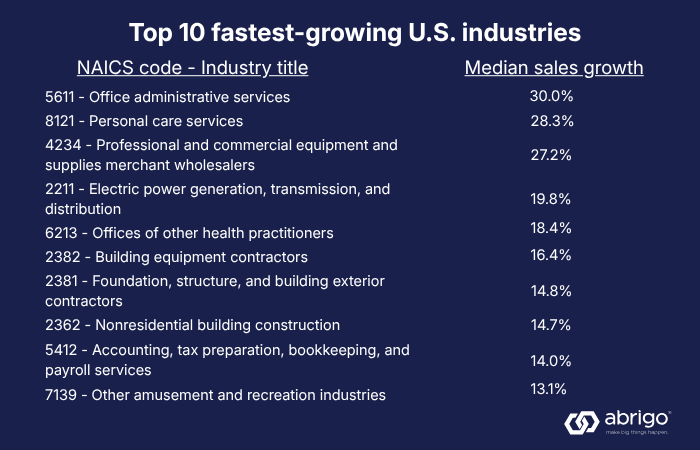
The insights are drawn from one of the largest real-time datasets of private-company financial statements in the U.S., offering a timely, granular view of small- and mid-sized-business performance for the 12 months ended March 1.
Thousands of banks, credit unions, and accounting firms use Abrigo Connect and other Abrigo solutions to assess borrower credit risk, analyze private-company performance, estimate business value, fight financial crime, and track industry trends. Abrigo’s cooperative data model spans more than 1,400 classified industries and includes over 80 financial data points from income statements, balance sheets, and key ratios.
Administrative and accounting services advance
Office administrative services topped the list of the 10 fastest-growing U.S. industries with a median sales growth rate of 30.0%. Businesses have increasingly shifted toward outsourcing back-office functions, such as billing, recordkeeping, and personnel support, to reduce overhead costs and address hiring challenges amid increased remote work. Some of the growth could also reflect recent mergers and acquisitions among firms in the data sample.
Accounting, tax preparation, bookkeeping, and payroll services also posted solid growth, with a median sales increase of 14.0%. Demand for outside help with tax, payroll, bookkeeping, and advisory work has remained steady, with higher revenue in audit, tax, and client advisory services, according to AICPA survey data. Higher billing rates may also have supported top-line growth.
Bright spots in construction and energy
Several of the fastest-growing industries were tied, directly or indirectly, to large nonresidential projects such as data centers, distribution facilities, and related infrastructure. That does not mean all construction businesses shared equally in the gains. Rather, it suggests companies serving the strongest project types had a better year than broader construction category labels might imply.
Even with softer conditions in parts of commercial construction, nonresidential building construction companies (general contractors and construction management firms) posted a median sales growth rate of 14.7%.
Professional and commercial equipment and supplies merchant wholesalers ranked third, with median sales growth of 27.2% over the last 12 months. The category covers a wide range of distributors, including firms tied to technology, medical equipment, and industrial machinery, which have seen a surge in investment.
Data center construction has created huge demand for electrical, HVAC, and other mechanical building system installation or servicing. Building equipment contractors posted median sales growth of 16.4%.
Data center projects, along with expanding logistics networks and infrastructure projects initiated with pandemic-era stimulus, have also favored structural steel and concrete contractors, which fall under foundation, structure, and building exterior contractors. That industry had a median sales growth rate of 14.8%.
On the energy front, electric power generation, transmission, and distribution posted a median sales growth rate of 19.8%. Electricity demand over the last year has been driven by large commercial projects, including data centers, and recently completed manufacturing facilities. Some portion of the increase may also reflect pricing or regulated revenue effects.
Personal care services in demand
Consumer and patient spending appear to have supported several service industries tied to care, wellness, and recreation. The global wellness market is projected to grow nearly 8% a year until 2029, according to the Global Wellness Institute, and the U.S. is the largest market at $2.1 trillion in 2024.
Personal care services was the second-fastest growing U.S. industry, posting median sales growth of 28.3%. The industry category includes hair, nail, and skin care services, as well as weight-loss centers and spas.
The aging U.S. population and growing demand for mental health services following the pandemic have also been boosting spending for health services. Offices of other health practitioners, which include mental health practitioners and physical therapists, posted median sales growth of 18.4%.
Wellness and continued spending on experience-based and recreational activities also fueled growth at fitness centers, golf courses, and other facilities over the past year. Other amusement and recreation industries, a category that includes these facilities, had a median sales growth rate of 13.1% over the last 12 months. The National Golf Foundation reports that rounds of golf played remain above pre-pandemic levels.
Taken together, the data suggests that growth over the past 12 months has been concentrated rather than broad-based. Industries aligned with outsourcing, infrastructure investment, and wellness demand have captured a disproportionate share of that growth. For lenders and analysts, this underscores the importance of looking beyond broad industry categories to identify where performance is most resilient.
“These trends highlight where demand is durable today, but they also point to where risk could emerge if conditions shift,” Tirunellayi said. “As investment cycles evolve and interest rates and operating conditions change, lenders will need to actively monitor concentration risk and borrower performance within these high-growth segments.”
About Abrigo
Abrigo is a leading provider of risk management, financial crime prevention, and lending software and services that help more than 2,400 financial institutions manage risk and drive growth in a rapidly changing world. Our AI-powered product portfolio helps institutions harness their data and leverage AI while maintaining trust, compliance, and explainability. We deliver transformational technology, product innovation, world-class support, and unparalleled expertise so our customers can face complex challenges and make big things happen.
Media contact
Kep Lee
[email protected]