
Explainable AI vs. black-box AI in banking: What examiners expect and what to ask your vendor

Sriram Tirunellayi
July 10, 2026
0 min read

What AI explainability means and why it matters in financial services 

As financial regulators focus on AI governance, explainable AI is quickly becoming a regulatory expectation. Learn explainability techniques and what banks and credit unions should ask AI vendors.

How does explainable AI in banking compare to black-box AI? 

Explainable AI (XAI) is any artificial intelligence system that shows why it generated a certain output, including what influenced it, how, and how much. Black-box AI produces outputs without enough transparency to understand the model’s approach, limitations, reliability, or the factors driving a specific decision.

For banking compliance officers and other technology decision makers, AI explainability is tied to regulatory and examination expectations, so it is a business necessity rather than merely a technical consideration. An opaque AI model can make it harder for financial institutions to validate, document, and defend AI-driven decisions, whether they are in credit underwriting, financial crime investigations, customer service, or other areas. Financial institutions must know how the AI works and how to know if it’s working right.

Here’s what examiners expect, how XAI works in practice, what questions every bank or credit union should ask an AI vendor, and how Abrigo delivers explainable AI solutions.

Related webinar: "Defensible AI in financial services: How to operationalize AI safely and effectively"

Watch the webinar

Explainability is becoming a compliance requirement

As financial regulators increase their focus on AI governance, explainable AI is quickly becoming a regulatory expectation. Across the banking industry, regulators have sent the same message: if AI influences an important business decision, the institution must be able to explain how the technology reached its conclusion. Saying a model is a "black box" is insufficient.

SR 26-2 and model risk management

The expectation starts with model risk management. Earlier this year, the Federal Reserve, FDIC, and OCC issued SR 26-2, which replaces SR 11-7 and SR 21-8. At its core, the guidance says institutions need to understand and manage their models well enough to manage the risks of their use. That includes model design, assumptions, data, methods, limitations, performance, and monitoring. The principles apply to AI and machine learning models used in banking as well as traditional statistical and quantitative models. Credit unions should view these expectations through their own supervisory framework, including NCUA’s risk-management focus for AI use.

FFIEC IT Examination Handbook

But explainability extends well beyond model risk. The FFIEC IT Examination Handbook warns that AI lacking transparency or explainability can be “unclear how inputs are translated into outputs,” increasing compliance and operational risk.

Reg B

Regulation B requires creditors to provide specific reasons for adverse credit actions, including when AI is involved. Saying the technology was too complex or opaque to understand doesn’t void the obligation. Fair lending reviews also depend on understanding why models produce the outcomes they do related to credit access, pricing, and underwriting. AI explainability is essential for identifying and managing potential bias.

Other organizations

Other leading organizations reinforce an emphasis on explainability. The Financial Action Task Force (FATF) has highlighted explainability and transparency as key considerations for AI used in AML and financial crime solutions. The GAO defines explainability as the ability to understand how and why an AI system produces its decisions, predictions, or recommendations. The National Institute of Standards and Technology (NIST) builds on that definition with four principles: explanations should be supported, meaningful to the intended audience, faithful to the model's actual behavior, and transparent about the model's knowledge limits.

These principles align closely with what banking supervisors increasingly expect. Whether the issue is model risk management, fair lending, or AML, the question is ultimately the same: Can the institution explain how its AI reached a decision and when that decision should not be trusted? That's the difference between explainable AI and a black-box model. It is also the difference between AI that can withstand regulatory scrutiny and AI that cannot.
How explainable AI works in practice

AI explainability isn't one-size-fits-all. The degree and output should fit the use case and depend on the type of AI and the decision being made. For predictive AI, explainability focuses on why a model made a prediction or score. For generative AI, it's about understanding how a response was produced, including the prompts, retrieved information, and supporting evidence. For agentic AI, explainability extends a step further, capturing why the AI chose a particular course of action and the sequence of decisions it took to complete a task.

Regardless of the technology, the goal is the same: make AI decisions understandable, traceable, and defensible. In practice, XAI can utilize many techniques. These include feature attribution, reason codes, confidence scores, prompt and response traceability, supporting evidence, action logs, or other artifacts that help analysts, validators, auditors, and examiners understand how an AI system reached its conclusion.

Two explainability techniques common in banking AI

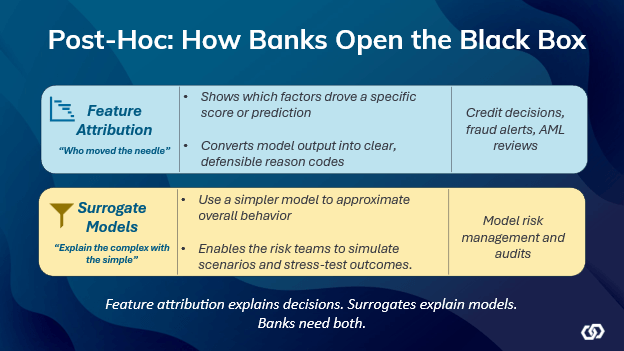
For predictive AI models, the two explainability techniques financial institutions are most likely to encounter are SHapley Additive exPlanations (SHAP) and Local Interpretable Model-Agnostic Explanations (LIME). They are not regulatory requirements, but they have become widely used methods for opening the black box.

SHAP

SHAP explains why a model reached a specific score or decision by showing how much each input contributed to the outcome. For example, in banking, it can identify whether cash flow, debt levels, or transaction behavior had the greatest influence on a credit decision, fraud score, or AML alert. Being able to attribute specific influencing features can be useful for supporting internal review, model validation, and adverse action analysis.

LIME

LIME takes a different approach. Rather than assigning contribution values to each feature, it builds a simpler approximation of the model around a single prediction. The surrogate model helps analysts and validators better understand the model's behavior for that specific decision.
The important point isn't whether an AI solution uses SHAP, LIME, or another explainability technique. It's whether the system can produce clear, defensible explanations and the evidence to support them that stand up to model validation, audits, and regulatory examinations.

Graphic showing AI explainability techniques

Banks and credit unions evaluating AI vendors should ask whether the system provides SHAP, LIME, reason codes, or an equivalent method for explaining individual outputs. The answer should include how explanations are generated, whether they can be exported, who can access them, and how they are documented for validation, audit, and examination.

Examples of problems with black-box AI

Black-box AI creates practical problems because banking decisions must be explainable to several audiences: customers, compliance staff, validators, auditors, management, boards, and examiners. Predictive performance alone does not answer the institution’s governance questions. Examples of how black-box AI can be problematic include:

  1. Loan denial with no usable reason code. A credit model recommends denial, but the institution cannot identify the principal factors that drove the decision. That creates adverse action risk under Regulation B and CFPB guidance.
  2. Fraud alert with no explainable trigger. If an analyst cannot determine which activity caused a fraud detection system to flag an account or transaction, the review may take longer. Documentation may be weaker, and confidence in the alerting process may decline, as the FFIEC Handbook warns.
  3. Model drift goes undetected. A model may perform differently over time as borrower behavior, market conditions, products, or data quality changes. SR 26-2 describes ongoing monitoring, including whether a model continues to perform as expected, as part of model risk management. An institution that cannot understand what is changing in the model’s behavior may have difficulty identifying problems or deciding when remediation is needed.
  4. Fair lending review cannot identify outcome drivers. An examiner, auditor, or compliance officer asks which variables influenced different outcomes across applicants or markets. If the institution cannot evaluate the drivers of model outcomes, it may struggle to assess fair lending risk, test for unintended bias, or explain how the model is being controlled.

An explainability checklist for AI vendors

Vendor due diligence should include whether the financial institution can oversee, validate, monitor, and document the AI system throughout its lifecycle.

Ask vendors these XAI questions:

  • What is the model’s intended use, and what uses are out of scope?
  • What data is used to train, test, and operate the model?
  • What validation documentation is available, including assumptions, limitations, methodology, and performance?
  • Can the system explain individual decisions, recommendations, alerts, or scores?
  • Does the system provide SHAP, LIME, reason codes, feature attribution, or an equivalent explanation method?
  • Can explanations be exported for audit, validation, or examiner review?
  • Does the system support accurate adverse action reasons when used in credit decisions?
  • How are performance, drift, data quality, retraining, and version updates monitored and documented?
  • What audit trail is maintained, including inputs, outputs, timestamps, users, overrides, and final decisions?
  • How does the vendor support independent validation, examiner review, and alignment with FFIEC, consumer compliance, and internal governance expectations?
  • What controls prevent unauthorized changes or inappropriate use?
  • For community financial institutions, the goal is practical exam defensibility. The institution should be able to show what the AI system does, how it is controlled, how performance is monitored, how exceptions are handled, and how decisions or recommendations can be explained.

How Abrigo delivers explainable AI

Explainability isn't something Abrigo adds after an AI model is built; it's designed into the entire AI lifecycle. Whether AI is making a prediction, generating a recommendation, or executing an agentic workflow, every outcome should be understandable, auditable, and aligned with the institution's governance requirements.

Strong model governance

Abrigo starts with strong model governance. AI models undergo independent third-party validation before deployment and are supported by comprehensive documentation describing their intended use, development methodology, assumptions, limitations, performance, governance, and monitoring. This gives financial institutions the information they need to incorporate Abrigo's AI into their own model risk management programs.

Decision-level explainability

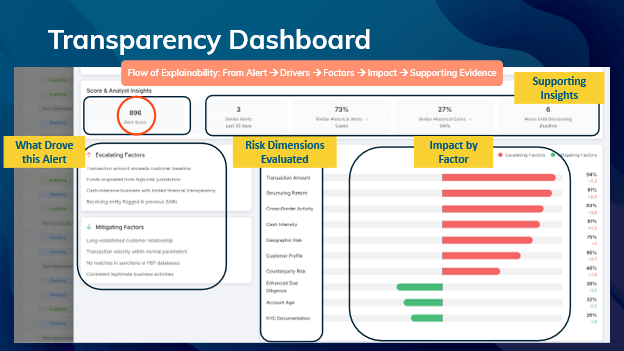
For AI-driven predictions, Abrigo provides decision-level explainability using SHAP-based feature attribution. Rather than presenting only a score, the platform identifies the factors that most influenced the outcome and translates them into intuitive, human-readable explanations. Analysts can understand what drove a credit decision, fraud score, or AML alert, making decisions easier to review, document, and defend.

Graphic showing Abrigo Fraud Detection's transparency dashboard

Traceability

For AI-generated recommendations and agentic workflows, explainability comes through traceability. Abrigo records user prompts, AI responses, supporting citations, timestamps, user identity, interaction history, and administrative actions, creating a comprehensive audit trail that can be exported for governance, audit, and examiner review. As AI agents perform increasingly sophisticated tasks, Abrigo also emphasizes policy alignment, human oversight for higher-risk situations, and continuous quality controls so institutions retain control over AI-assisted actions.

Model monitoring

Explainability also extends beyond individual decisions. Abrigo continuously monitors its consortium-trained AI models for performance, feature stability, data drift, and prediction quality. When meaningful changes are detected, models are reviewed and refreshed as appropriate to help ensure they continue to perform as intended.

Ultimately, AI explainability is about trust. Analysts need to understand what drove a recommendation. Validators need evidence that models behave as expected. Auditors need a complete record of AI activity. And examiners need confidence that AI-assisted decisions can be understood, challenged, and defended.

That's the philosophy behind Abrigo's AI platform. Abrigo’s AI is built not only to be intelligent but also explainable, auditable, and governed from end to end.

Explainability from the start for AI governance

In a regulated environment, an AI system’s value depends on whether the institution can use it responsibly, control it effectively, and explain it when asked. Explainability should be part of AI governance from the start. Financial institutions evaluating AI should require clear documentation, individual-level explanations where needed, audit trails, performance monitoring, and vendor support for validation and examiner review.

The information, content, and materials provided through this website are for informational purposes only and are not intended to constitute legal advice. Customers should consult with their legal counsel regarding the application of laws and regulations to their specific circumstances.

About the Author

Sriram Tirunellayi

Director of Applied AI
Abrigo
Sriram Tirunellayi (Sri) is Director of Applied AI at Abrigo, where he drives AI product strategy and innovation that helps financial institutions manage risk and drive growth. Before joining Abrigo in 2024, he worked with startups and Fortune 500 companies such as Equifax driving AI/ML and data and analytics product

Full Bio

About Abrigo

Abrigo enables U.S. financial institutions to support their communities through technology that fights financial crime, grows loans and deposits, and optimizes risk. Abrigo's platform centralizes the institution's data, creates a digital user experience, ensures compliance, and delivers efficiency for scale and profitable growth.

Make Big Things Happen.