
Explainability is becoming a compliance requirement
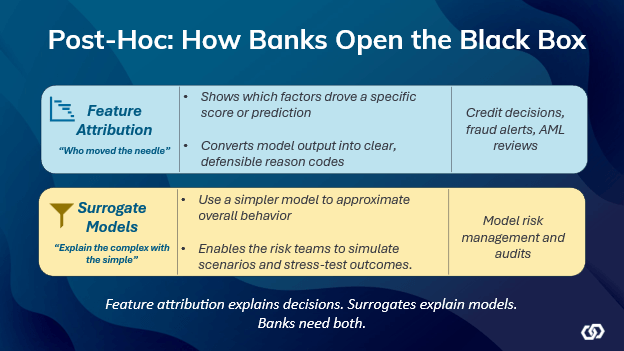
As financial regulators increase their focus on AI governance, explainable AI is quickly becoming a regulatory expectation. Across the banking industry, regulators have sent the same message: if AI influences an important business decision, the institution must be able to explain how the technology reached its conclusion. Saying a model is a "black box" is insufficient.
SR 26-2 and model risk management
The expectation starts with model risk management. Earlier this year, the Federal Reserve, FDIC, and OCC issued SR 26-2, which replaces SR 11-7 and SR 21-8. At its core, the guidance says institutions need to understand and manage their models well enough to manage the risks of their use. That includes model design, assumptions, data, methods, limitations, performance, and monitoring. The principles apply to AI and machine learning models used in banking as well as traditional statistical and quantitative models. Credit unions should view these expectations through their own supervisory framework, including NCUA’s risk-management focus for AI use.
FFIEC IT Examination Handbook
But explainability extends well beyond model risk. The FFIEC IT Examination Handbook warns that AI lacking transparency or explainability can be “unclear how inputs are translated into outputs,” increasing compliance and operational risk.
Reg B
Regulation B requires creditors to provide specific reasons for adverse credit actions, including when AI is involved. Saying the technology was too complex or opaque to understand doesn’t void the obligation. Fair lending reviews also depend on understanding why models produce the outcomes they do related to credit access, pricing, and underwriting. AI explainability is essential for identifying and managing potential bias.
Other organizations
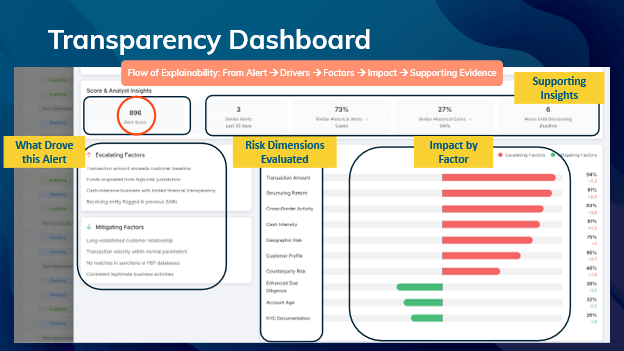
Other leading organizations reinforce an emphasis on explainability. The Financial Action Task Force (FATF) has highlighted explainability and transparency as key considerations for AI used in AML and financial crime solutions. The GAO defines explainability as the ability to understand how and why an AI system produces its decisions, predictions, or recommendations. The National Institute of Standards and Technology (NIST) builds on that definition with four principles: explanations should be supported, meaningful to the intended audience, faithful to the model's actual behavior, and transparent about the model's knowledge limits.
These principles align closely with what banking supervisors increasingly expect. Whether the issue is model risk management, fair lending, or AML, the question is ultimately the same: Can the institution explain how its AI reached a decision and when that decision should not be trusted? That's the difference between explainable AI and a black-box model. It is also the difference between AI that can withstand regulatory scrutiny and AI that cannot.