Guide to AI automation for community banks

Mary Ellen Biery
September 8, 2026
0 min read

What, when, and how to begin using AI in banking 

A guide showing how to implement AI automation for community banks: Use cases, when it makes sense to automate with AI, and governance and vendor considerations.

How community banks can automate using AI

Community banks are scrappy by their nature.  

They compete with larger financial institutions that have bigger technology budgets and specialized teams. At the same time, they face many of the same expectations for fast service, effective risk management, fraud prevention, and regulatory compliance. 

On the surface, then, artificial intelligence (AI) sounds promising for its ability to save time, do more with the same resources, and serve customers better. But determining where generative AI, AI agents, machine learning, and automation can realistically help a community bank seems complicated, given small IT teams and leaders who handle multiple operational areas. 

Expand your AI knowledge with content from a trusted industry source

Visit the AI Hub

AI automation for community banks should address a specific operational problem: too much manual data entry, slow document reviews, repetitive compliance work, lengthy document preparation, or a growing volume of alerts and emails. 

It’s unnecessary to entertain automating every process or removing employees from decisions that require experience, accountability, or knowledge of the customer. Instead, the practical approach to AI:
• Identifies work that technology can handle consistently
• Determines where human judgment still belongs, and
• Builds appropriate controls around both types of activities.  

This guide looks at where AI-assisted automation can fit within lending, AML/CFT compliance, fraud prevention, and other banking operations. It also covers newer concepts and AI terminology, such as agentic AI, along with the governance considerations community banks should evaluate before putting those technologies to work on specific use cases.
 

What is AI automation and how does it apply to community banking?

AI automation combines artificial intelligence with automated workflows so technology can perform or assist with tasks that previously required more manual review, analysis, classification, drafting, or data handling.

Traditional automation is familiar to most community bankers. Relying on fixed rules and instructions, automation routes a loan application to the correct employee once certain conditions are met, or it generates a document after the requisite approval. Another common example: automated alerts for transactions exceeding a predetermined threshold.

AI automation use cases: Loan origination, FinCrime, and more

AI can extend those automated workflows. Consider a commercial loan application. An AI-enabled process could read and interpret related documents, extract financial information, and prepare part of the analysis for review. Lending, compliance, and financial crime are areas where community financial institutions often face operational friction due to fragmented, manual processes. Their data-intensive, repetitive nature makes them ideal starting points for AI automation to turbo-charge efficiency.

Depending on the AI technology, AI can also recognize patterns and generate text. Agentic AI refers to AI systems using one or more AI agents to complete multi-step workflows with minimal human input. These systems can sequence tasks and coordinate actions across tools and data sources. In other words, AI can move work forward while routing exceptions or higher-risk decisions to employees.

The ability to separate work streams that require staff review from those that do not is an important consideration for AI automation for community banks, which take pride in and distinguish their services by their ability to make local decisions based on deep knowledge of their communities and customers. AI automation can give bankers more time for value-added, relationship-focused activities.

Examples of AI-assisted work for community bank functions to consider are shown below.
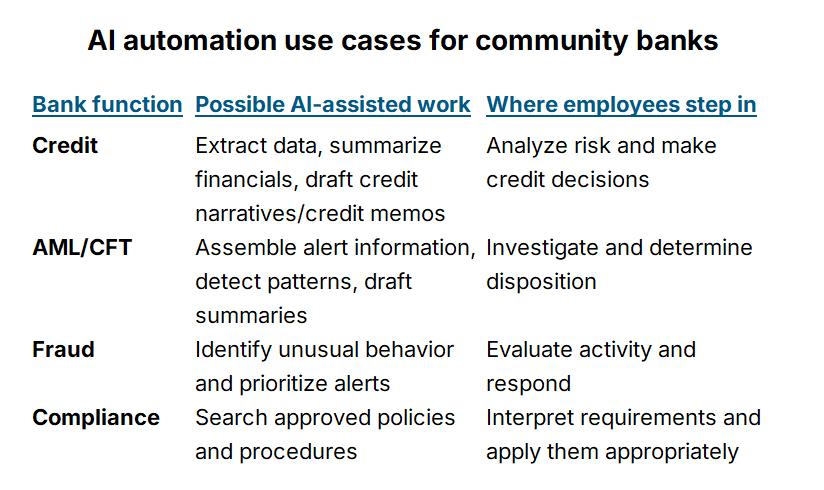
Table showing AI automation use cases for community banks

Improved efficiency from AI can increase output, boost quality control, create opportunities to support other compliance priorities, and coach new employees.

In F&M Bank’s BSA department, for example, investigators save about 5 minutes for every alert using Abrigo’s AML Assistant. Across the bank’s hundreds of alerts each month, this translates into dozens of hours of recovered investigative capacity. Old National Bank’s loan reviewers reported average efficiency improvements of about 31% in its commercial credit risk review process from using Abrigo’s AI-powered Loan Review Assistant.

AI automation vs. traditional bank technology

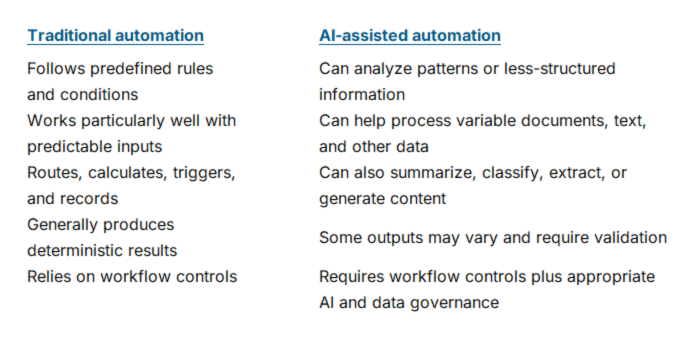
The simplest distinction between traditional banking technology and AI automation that community banks are using is that conventional automation generally follows rules, whereas AI can help interpret information within the routine work processes.

Chart of features for traditional automation vs. AI-assisted automation for community banks

Both traditional and AI automation have a place in  community financial institutions.

When is a community bank ready to use AI?

A bank does not need billions of dollars in assets to identify a practical AI use case. The most important determinant is whether the financial institution has a clearly defined problem, usable data, appropriate oversight, and a process that can be tested.

Considering an AI application? Begin by answering questions such as:

  • What specific problem are we trying to solve?
  • How does the process work today?
  • Who owns the process?
  • What data would the technology need?
  • What information should it not be allowed to access?
  • Which output or action requires human review?
  • How will we know whether the technology is performing as expected?
  • What happens when it does not?

These questions can make a small, contained use case focused and manageable.

Governance considerations: Boundaries before deployment

Abrigo surveys routinely show that governance is a major concern among community banks considering AI solutions. But a formal AI project might be only part of a bank’s governance challenge. Employees may already be experimenting with generative AI through publicly available tools.

Good AI governance starts with straightforward questions and communication with employees.

Can employees enter customer information into a public AI system? Which tools are approved? Can AI-generated material be sent to a customer before review? Who investigates an unexpected output?

Two resources for the financial sector that can help financial institutions develop an AI governance framework are the Artificial Intelligence Lexicon and the Financial Services AI Risk Management Framework (FS AI RMF) released by the U.S. Treasury in 2026. The FS AI RMF adapts the National Institute of Standards and Technology’s voluntary AI Risk Management Framework to the specific considerations of financial institutions.

A community bank’s controls should reflect the particular use case and its potential consequences. Areas worth addressing include:

  • Data access and privacy
  • Human review and approval
  • Documentation and audit trails
  • Model or system performance
  • Vendor oversight
  • Procedures for errors and exceptions

The bank should also decide who is responsible for AI governance. Depending on the AI use case, that responsibility may involve business leaders, compliance, risk, information security, IT, vendor management, or a cross-functional group.

Choosing an AI automation platform

A product demonstration can make complicated technology look remarkably easy.

Take a closer look.

Bank leaders should understand how the tool would operate once it meets their data, their employees, and their existing systems. Some questions that can help:

  1. Which specific workflow will improve? What problem is the AI solving?
  2. What data does the system use? Ask where information comes from, where it goes, and how long it remains there.
  3. Where does human judgment remain? Where will employees review the output and does your community bank have a choice in how much oversight to provide?
  4. How do we defend this to examiners and auditors? What documentation and auditability features are included to create a defensible record?
  5. How will performance be monitored? Ask how errors, drift, model changes, and unexpected results are documented.

Banking experience of the vendor deserves consideration, too. Financial institutions operate with privacy, compliance, audit, and risk-management obligations that general business users may not face in the same way. And consider the solution provider’s experience in meeting the unique needs of community banks, especially regarding integrations, customer service, and training.

Abrigo has more than 2,400 financial institution customers, including a large share of the community bank market. The company's integrations, customer service, and training staff have been meeting community banks' needs for more than 25 years.

Getting started with AI and measuring ROI

Start AI use cases where the friction is easiest to see. Employees usually know which processes fit that description. Maybe lenders are entering borrower information into multiple places. Perhaps investigators spend hours compiling alert histories. An operations employee may repeatedly search several documents to answer the same internal questions.

Before making changes, measure how the process works today. Capture staff time, turnaround time, error rates, alert volumes, or other indicators that show where the friction exists in a given task before you automate it.

After automation, give employees a clear way to review the technology’s work and ask where it saved time, where it added extra steps, and where the output missed important context.

If the project is successful, use what the bank learns to guide the next step. A measured approach gives community banks room to build experience with AI automation while keeping the technology tied to practical banking needs.

Moving from AI interest to practical use

AI can provide community banks an amazing opportunity to focus on what makes them different from larger institutions and fintechs. Ask some practical questions when evaluating an AI use case: What valuable work could employees spend more time doing if technology handled more of the routine tasks? What’s the current process? What data is involved? What controls are appropriate? How can we measure AI outcomes? Then get moving on AI automation that preserves the judgment, accountability, and relationships that community institutions depend on.  
This blog was written with the assistance of an AI large language model and was reviewed and revised by Abrigo's subject-matter expert.
 

Find out how Abrigo helps community banks automate and incorporate transparent, explainable AI

See AI solutions

The information, content and materials provided through this website are for informational purposes only and are not intended to constitute legal advice. Customers should consult with their legal counsel regarding the application of laws and regulations to their specific circumstances.

About the Author

Mary Ellen Biery

Senior Strategist & Content Manager
Mary Ellen Biery is Senior Strategist & Content Manager at Abrigo, where she combines financial journalism, original research, and SEO/AEO strategy to create authoritative content that helps financial institutions manage risk and pursue growth. A former Dow Jones Newswires equities reporter, her work has appeared in The Wall Street Journal,

Full Bio

About Abrigo

Abrigo enables U.S. financial institutions to support their communities through technology that fights financial crime, grows loans and deposits, and optimizes risk. Abrigo's platform centralizes the institution's data, creates a digital user experience, ensures compliance, and delivers efficiency for scale and profitable growth.

Make Big Things Happen.