Looking for Valuant? You are in the right place!

Valuant is now Abrigo, giving you a single source to Manage Risk and Drive Growth

Make yourself at home – we hope you enjoy your new web experience.

Looking for DiCOM? You are in the right place!

DiCOM Software is now part of Abrigo, giving you a single source to Manage Risk and Drive Growth. Make yourself at home – we hope you enjoy your new web experience.

Looking for TPG Software? You are in the right place!

TPG Software is now part of Abrigo. You can continue to count on the world-class Investment Accounting software and services you’ve come to expect, plus all that Abrigo has to offer.

Make yourself at home – we hope you enjoy being part of our community.

What is digital lending and how can community banks, credit unions benefit?

Mary Ellen Biery
March 2, 2026
0 min read

Questions & answers about online loan origination

Digital lending can deliver faster and more efficient credit decisions. It's increasingly common among banks and credit unions, and it yields numerous benefits outlined below.

Q: What is digital lending for banks and credit unions?

A: Digital lending is the use of online technology to originate and renew loans in order to deliver faster and more efficient credit decisions. Digital lending can start as basic as an online loan application offered by a bank or credit union on its website. It can also be as comprehensive as an entirely automated loan origination system that digitizes the full process using software for an online loan application, document capture, electronic signatures, automated credit analysis, loan pricing, loan decisioning, and loan administration.

Also see this infographic: "Before & after: Digital lending and credit automation"

Download infographic

Q: Why is it urgent for community banks and credit unions to adopt digital lending?

A: In the world of Amazon same-day deliveries and instant payments, convenient options for applying for credit are table stakes. Non-bank lenders already offer them, and digital financial tools are everywhere. Consider this: More than three-fourths of consumers use fintech applications, according to a recent survey of 2,000 U.S. adults by Plaid and the Harris Poll. One in every five expect to use an app for lending services in the next six months—up from 10% in 2020. Finally, the same consumer survey found nearly half of consumers consider the typical loan application process too confusing; 39% said it was challenging to even successfully complete a loan application. Traditional lending processes also cost more. “Banks can realize huge gains in operational efficiency by automating more manual processes, using workflow management tools and underwriting algorithms that spit out decision and approval. They can also use digital tools to raise employee productivity,” write Bain & Co. advisors. The firm has long recommended banks modernize lending processes to avoid a material decline in profits and loss in market share.
Q: How common is digital lending among traditional financial institutions?

A: According to a 2024 survey by Digital Banking Report Research, 90% of institutions allowed consumers to apply online for consumer credit, such as a personal line of credit, a credit card, or an auto loan. Sixty-five percent reported providing mobile apps for borrowers to apply for consumer credit. However, many types of credit applications still require in-person visits to a branch. Only 36% of financial institutions rely on digital lending platforms for more than half of their lending processes, according to PYMNTS Intelligence’s 2024 State of Digital Lending Readiness Report.

Q: Among financial institutions, which lending segments are most and least digitized today?

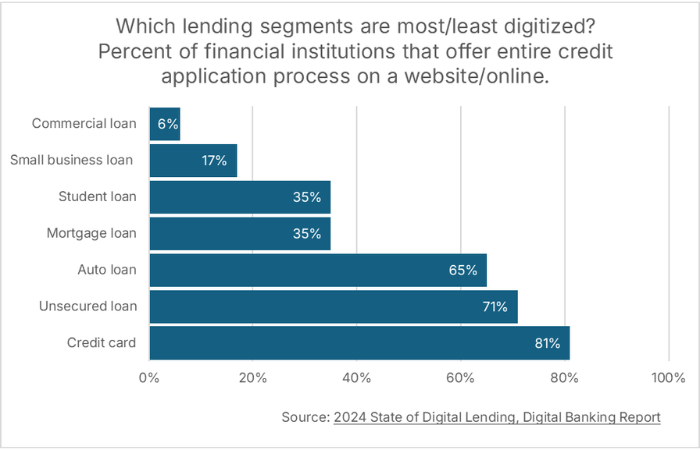
A: Across all product types, nearly 90% of financial institutions make available online/web applications for credit, an increase from 76% in 2019, according to Digital Banking Report’s 2024 State of Digital Lending study. However, most potential borrowers can complete only a portion of the entire credit application process online. That’s especially the case for business or commercial loans, student loans, and mortgages. Small business and commercial lending processes are the least digitized, and credit cards and unsecured personal loans are the most, according to the study.

bar chart showing how lending segments are digitized

Q: What parts of the lending process should institutions digitize first, and what benefits will they see?

A: Focus on three areas:

1. Information collection: Clarify requirements upfront, reduce borrower frustration, and prevent delays from incomplete files. Online applications create a single data source and reduce the risk of errors from rekeying data. Financial packages update automatically as data is added, and staff don’t spend as much time emailing and calling for incomplete loan applications. Once the borrower signals with a completed file that they are ready to move forward with the application, the processing and underwriting can proceed more efficiently.

2. Workflows: Digital lending software that utilizes configurable workflows means all information related to a borrower can be seen in one centralized place, and the steps of a decision can be documented for improved audit tracking. Connecting multiple data sources into a single interface enables loan processors or analysts to import information from third parties, such as credit bureaus, insurance firms, appraisal firms, and other financial institutions. This reduces errors and extra work, speeding up the decision-making process.

3. Analytics and intelligence: Standardize calculations and analyses to improve consistency and reliability across lenders, underwriting teams, and branches. A digital platform can analyze, price, and recommend loan decisions more quickly while generating portfolio insights that support better risk understanding and strategic decisions. Management and boards can more easily see concentration risk and growth opportunities.

Q: How does digital lending improve the borrower experience and help institutions grow without adding staff?

A: Digitization speeds up decisions, increases transparency about requirements and timelines, and reduces rework from errors or missing documents, directly improving the borrower or member experience. For example, Abrigo’s AI-powered Lending Assistant generates credit narratives 25% faster, validates documents, and extracts key data from unstructured files. For the institution, efficiency gains translate into lower operating costs, better profitability, and the capacity to close more loans and increase revenue per loan. This fosters growth in loan portfolios without proportionally increasing staff or risk, and can free resources to enhance service or help contain fees and rates.

Q: Does digital lending replace the relationship lender in many community banks and credit unions?

A: No. Automating time-consuming lending processes, such as document collection and financial spreading, does not replace the lender’s relationship. Instead, it allows staff who normally handle those tasks to direct their time to talking with the customer or member and other staff about needs and which products serve them best. They can also spend more time educating applicants on the credit process and how borrowers can improve their chances of loan approval. In addition, some business borrowers prefer to begin applying in person. For example, Academy Bank’s recent survey of more than 200 entrepreneurs found that more than half applied for loans in a branch, and those working with a dedicated business banker reported positive experiences. However, the survey found a digital-first mindset among younger generations. More than half of Gen Z business owners and 43% of Millennials prefer digital banking options—whether it’s applying online, using mobile tools, or managing their accounts virtually. 

Q: What's the role of AI (artificial intelligence) in digital lending? 

A: AI is transforming digital lending, making processes even faster and less burdensome for busy lenders and credit analysts. For example, Abrigo's AI-powered banking agent, AskAbrigo, is integrated with the loan origination system. Instead of lenders searching through scattered loan files, emails, and policy documents on SharePoint to prepare for a prospect meeting, AskAbrigo can create a comprehensive relationship summary (loans, deposits, ticklers, covenants, guarantors, potential concerns, topics to discuss) from the institution's own data and files, then create a calendar activity and link a summary that can be used to guide the conversation. Early users report saving anywhere from 30 minutes to 5 hours a week on various use cases.


Helping more borrowers get answers quickly

Innovations in digital lending will continue as financial institutions seek additional ways to serve their customers or members while protecting the safety and soundness of the institution. Technology enables an institution to infuse more of its unique banking expertise into workflows, thereby retaining its relationship-driven advantages and preserving community lending. 

Find out how Abrigo Lending Assistant creates credit narratives 25% faster.

Abrigo Lending Assistant
About the Author

Mary Ellen Biery

Senior Strategist & Content Manager
Mary Ellen Biery is Senior Strategist & Content Manager at Abrigo, where she works with advisors and other experts to develop whitepapers, original research, and other resources that help financial institutions drive growth and manage risk. A former equities reporter for Dow Jones Newswires whose work has been published in

Full Bio

About Abrigo

Abrigo enables U.S. financial institutions to support their communities through technology that fights financial crime, grows loans and deposits, and optimizes risk. Abrigo's platform centralizes the institution's data, creates a digital user experience, ensures compliance, and delivers efficiency for scale and profitable growth.

Make Big Things Happen.