

Financial institutions of all sizes are looking for ways to automate manual, time-consuming processes through modern workflow technology and artificial intelligence. Those investments can reduce operational costs, improve employee productivity, and accelerate lending processes. But looking ahead to the end result of these efficiencies is what differentiates a bank or credit union from its competitors.


Abrigo surveyed 1,020 consumers about how they borrow, what they expect from lenders, and how they feel about technology and AI in the lending process. The findings suggest that consumers value digital convenience and faster processes, but speed alone is not enough. Rates and affordability remain important, borrowers are cautious about taking on new debt, and visible use of AI can introduce concerns about trust and transparency.
More than half of consumers prefer a fully or mostly digital loan application experience. That preference rises to 68.5% among Gen Z and 68.8% among Millennials, compared with 36.0% of Boomers. But while older customers still prefer a human-centric approach, simply offering a digital application to those who want it does not necessarily create a better borrowing experience. The more important question for bank leadership is whether the process is designed around the customer.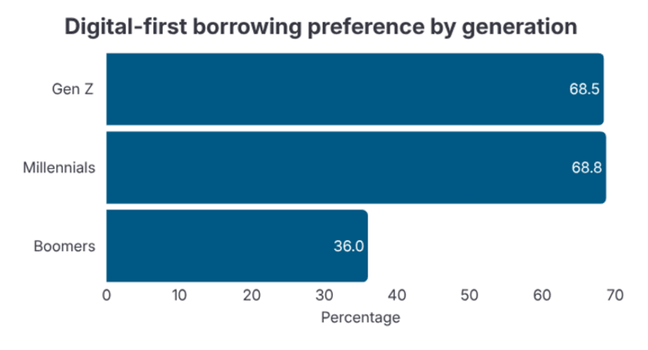
Financial institutions should look beyond whether they offer a digital application and evaluate how the entire borrower journey performs. How easily do customers find the right product? When do they learn which documents are needed, and how many times must they enter information? How long do they wait between steps, and how clearly is status communicated? How easily can they reach someone when they have a question?
After examining the customer point of view, map the lending team’s process from initial application through decision and funding. Which step takes the longest? Which tasks require staff to manually transfer information between systems? How are documents requested? How many handoffs occur before an application reaches an underwriter? Are simple or lower-risk loans following the same workflow as complex cases? The areas of friction here and in the customer timeline likely intersect.
Workflow integrations and carefully scoped auto-decisioning can compress those gaps, and knowing exactly which parts of the process to address first can help institutions implement technology more effectively. The time saved should create room for staff to step in when a borrower needs explanation or advice, without forcing every borrower into a fully automated experience.
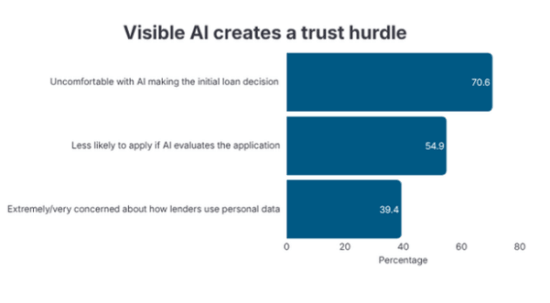
The survey revealed consumer concern about the role of AI in the borrowing process. More than 7 in 10 consumers (70.6%) say they are somewhat or very uncomfortable with AI making the initial loan decision. Another 54.9% say they would be less likely to apply if they knew AI was being used to evaluate their application, while 39.4% are extremely or very concerned about how lenders use their personal and financial data.
These findings shouldn’t prevent financial institutions from using AI to smooth and speed up the loan process. They merely prove that faster matters only when the borrower experience remains transparent and trustworthy.
Using AI or automation to assist with document collection, data entry, verification, routing, workflow prioritization, or other repeatable tasks can remove friction without fundamentally changing the relationship between borrower and lender. Using AI at the decision point requires greater care. If AI supports credit decisioning, lenders may need to be more deliberate about explaining its role, where human judgment remains involved, how exceptions are handled, and how borrowers can reach a person with questions.
 The broader survey findings reinforce the importance of trust. Only 21.5% of respondents said they were very confident in their ability to find a lender they trust, while another 36.7% were somewhat confident. Consumers also expressed uncertainty about whether they are receiving a fair rate, with only 22.3% reporting that they are very confident they know whether they are getting one.
Technology is entering a lending environment where trust should not be taken for granted. For institutions evaluating AI, efficiency should be considered alongside another question: Can we explain how the technology is being used in a way that supports borrower confidence?
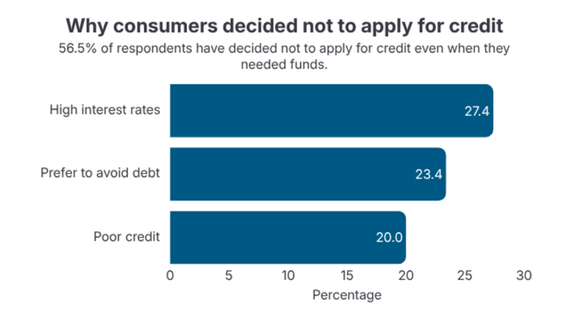
Efficiency is important, but consumers do not make borrowing decisions based on speed alone. More than half of respondents (56.5%) say they have decided not to apply for credit even when they needed funds. Among those consumers, the most common reason for walking away was high interest rates, cited by 27.4%. Another 23.4% said they preferred to avoid debt, while 20.0% cited poor credit. Fear of rejection, economic instability, lack of trust, and uncertainty about available products created additional barriers.
A financial institution can build an extremely fast lending process and still lose the borrower. If a consumer is worried about affordability, unsure whether they qualify, confused by the available products, or hesitant to take on debt, a faster application may not address the reason they hesitate.
Operational efficiency can help address some of those challenges. When technology handles routine processing work, employees can spend more time consulting with borrowers, helping them understand products, compare alternatives, understand payments and terms, evaluate affordability, and determine an appropriate next step.
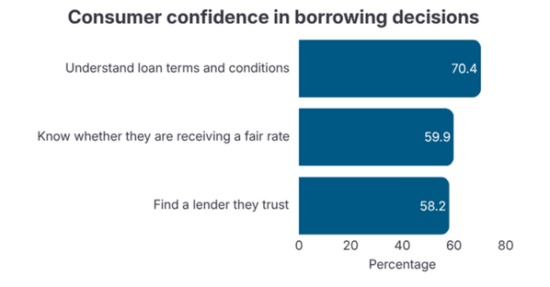
The survey suggests that consumer would appreciate more guidance. While 70.4% of respondents are at least somewhat confident in their ability to understand loan terms and conditions, only 59.9% are very or somewhat confident that they know whether they are receiving a fair rate. Similarly, only 58.2% report being very or somewhat confident in their ability to find a lender they trust.
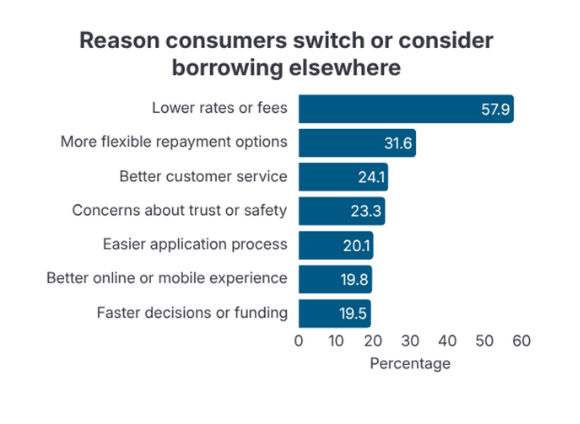
Among consumers with a primary lender, 57.9% say lower rates or fees would lead them to switch lenders or consider borrowing elsewhere. Interest rates and fees were also the single most important factor in lender selection, chosen by 42.8% of respondents.
Price clearly matters, but consumers identified several other reasons they could consider another lender. These include more flexible repayment options at 31.6%, better customer service at 24.1%, concerns about trust or safety at 23.3%, an easier application process at 20.1%, a better online or mobile experience at 19.8%, and faster decisions or funding at 19.5%.
This mix of concerns illustrates what lenders can gain from improving operations. The business case for lending technology becomes stronger when productivity gains are connected directly to borrower value. Efficiency can create capacity to compete across several dimensions simultaneously. Lower operating costs can create more flexibility around pricing. Better workflows can shorten decision times. Integrated systems can reduce repetitive data entry and make digital applications easier to use. Automated status updates can improve transparency. Freeing employees from repetitive administrative work can also create more time for customer service and financial guidance.
Hard-won relationships are not permanent. Among respondents with a primary lender, roughly one-third say they are very or somewhat likely to switch their primary lender within the next two years. Consumers also discover lenders through a wide variety of channels. Recommendations from friends and family led at 26.3%, followed closely by online search at 23.1%, while nearly one in five initially found their primary lender by walking into a branch.
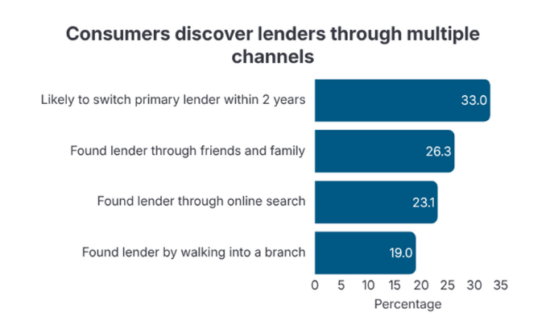
Consumers can increasingly discover alternatives digitally, while their lender decisions remain influenced by economics, trust, service, convenience, and personal relationships.
For banks and credit unions trying to grow consumer lending, operational improvements can therefore have implications beyond the back office. An easier application can improve conversion. Faster decisions can help an institution compete for borrowers comparing multiple providers. Clear communication can reinforce trust. More employee capacity can improve service and create opportunities for advice. Lower cost-to-serve can provide more flexibility around rates, fees, and product design.