



Looking for Valuant? You are in the right place!

Valuant is now Abrigo, giving you a single source to Manage Risk and Drive Growth

Make yourself at home – we hope you enjoy your new web experience.

Looking for DiCOM? You are in the right place!

DiCOM Software is now part of Abrigo, giving you a single source to Manage Risk and Drive Growth. Make yourself at home – we hope you enjoy your new web experience.

IFSLeaseWorks is now part of Abrigo.

Diversify your portfolio and earn additional interest income. End-to-end lease origination and administration automation make it possible.

Read the press announcement

Looking for TPG Software? You are in the right place!

TPG Software is now part of Abrigo. You can continue to count on the world-class Investment Accounting software and services you’ve come to expect, plus all that Abrigo has to offer.

Make yourself at home – we hope you enjoy being part of our community.

AI assistance for the CECL calculation is moving from theoretical to practical

For community financial institutions, the conversation around the future of artificial intelligence (AI) in banking is no longer theoretical. Leaders are asking practical questions about how AI helps banks operate more efficiently, where it delivers measurable value, and how it can be applied while maintaining transparency and trust. Nowhere is transparency more important than in a community financial institution’s CECL calculation.

Strengthening CECL processes with AI

Advances in automation and AI are creating new opportunities for teams to strengthen their CECL processes while maintaining the governance the standard requires. Now that the initial CECL implementation period is behind us, banks and credit unions are entering a new phase of figuring out how to manage their calculations most efficiently. The impact of AI on CECL processes will be most visible through enhancements that make complex processes easier to execute, explain, and defend.

Reduce your regulatory burden by working with our experts.

Learn more

The evolving role of AI in banking and why it matters for CECL

Across the industry, AI is helping banks reduce manual effort, improve consistency, and find insights more efficiently. In areas like CECL, where accuracy, governance, and documentation carry significant weight, these benefits are especially meaningful.

Most community financial institutions (CFIs) have already made the foundational CECL decisions

  • How reasonable and supportable forecasts should be applied 
  • What governance framework supports consistent qualitative adjustments 

But making those decisions was only the beginning. Many institutions are discovering that CECL’s real challenge lies in execution. Manual workflows, disconnected systems, and spreadsheet-driven processes can limit an institution’s ability to fully leverage the insight CECL is meant to provide. As portfolios grow and regulatory expectations mature, execution becomes the primary challenge. This is where many of the advantages of AI in banking begin to take shape, especially when paired with purpose-built CECL solutions.

Using automation and AI to strengthen CECL execution

One of the most immediate benefits of AI in banking is its ability to reduce friction in operationally intensive processes. When it comes to CECL, automation streamlines data ingestion, accelerates calculations, and standardizes workflows across portfolios and reporting periods. These capabilities help support more reliable reporting cycles and enable teams to manage documentation requirements more effectively.

For decision-makers, this is where AI begins to deliver tangible return on investment. Faster close cycles, fewer errors, and greater confidence in results all contribute to stronger operational outcomes and better use of expert time. CECL teams no longer need to spend excessive time navigating tools or managing workarounds. Instead, they can focus on understanding results and making informed decisions. 

Platforms that incorporate AI will evolve from calculation engines into end-to-end systems that support analysis, documentation, and review—without sacrificing human control or judgment.

Maintaining oversight and trust as AI adoption grows

Any discussion about the future of AI in banking must address governance and control. AI should not select methodologies, determine forecasts, or apply qualitative adjustments. Those responsibilities must remain firmly within management's purview. Where AI adds value in CECL is by supporting execution around established management decisions.

One of the most resource-intensive parts of the process is documentation. Allowance results must be supported by clear, regulator-ready explanations that answer questions such as:

  • Why did the allowance change this period? 
  • How were economic conditions incorporated? 
  • Which assumptions had the most impact? 

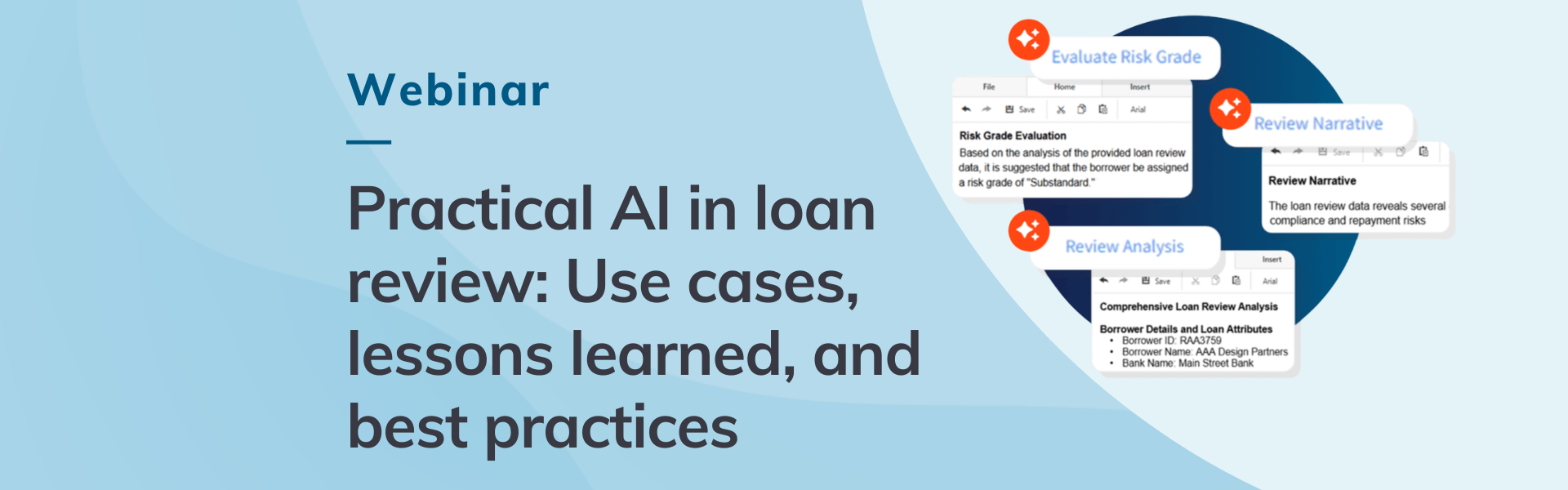
AI offers a practical way to improve consistency and ensure compliance when answering these questions. Generative AI can help transform structured CECL data into complete, standardized narratives, making explanations easier to produce, review, and maintain across reporting periods. The result is stronger documentation quality with fewer opportunities for omission or unfounded assertions.

When used thoughtfully within well-governed systems, AI becomes a natural extension of modern CECL platforms. It reinforces process discipline, supports audit readiness, and helps institutions operate more efficiently without compromising transparency or control. This approach reflects the broader future of AI in banking: responsible innovation that strengthens oversight, improves outcomes, and builds confidence with regulators and stakeholders.

The broader impact of AI on CECL and banking strategy

Looking ahead, the future of AI in banking will be shaped by usability and integration. Institutions that combine CECL expertise with modern automation and applied AI will be better positioned to reduce risk, improve efficiency, and communicate results with confidence.

For CECL teams, this means seeking solutions that simplify execution, support consistent analysis, and help derive greater value from the decisions they have already made. These capabilities reflect a broader shift across banking, where AI is becoming a practical tool for improving efficiency, accuracy, and insight across core processes.

The future of CECL closely mirrors the future of AI in banking as a whole. Progress will continue to be driven by thoughtful innovation that improves outcomes while maintaining strong governance and professional judgment.

FAQs

What does “CECL automation with AI” mean for banks and credit unions?

CECL automation with AI means using automation and AI features to reduce manual effort in CECL execution—such as data ingestion, calculation workflow standardization, documentation support, and review readiness. The goal is a more consistent and defensible allowance process. AI-assisted CECL software helps teams run repeatable reporting cycles without losing governance.

Where does AI add the most value in the CECL process?

AI adds the most value in operational execution, not in making management decisions. It can streamline data preparation, accelerate recurring calculations, and make documentation easier to assemble and explain. In CECL software for banks and credit unions, these improvements reduce friction across reporting periods.

What parts of CECL should not be delegated to AI?

AI should not select CECL methodologies, determine forecasts, or apply qualitative adjustments. Those responsibilities must remain with management to preserve accountability and regulatory defensibility. AI-assisted CECL automation should support analysis and documentation while keeping human judgment in control.

How does AI help improve CECL documentation and exam readiness?

AI can help by standardizing workflows, organizing supporting evidence, and improving the consistency of narrative and review artifacts across cycles. CECL software that evolves into an end-to-end system supports analysis, documentation, and review in one place. This strengthens audit trails and makes the allowance easier to defend

How should community financial institutions approach AI adoption for CECL?

Community financial institutions should focus on practical, governed use cases that improve execution—starting with automation that reduces manual steps and increases consistency. The best approach pairs CECL automation with clear oversight, transparency, and review controls. AI-assisted CECL software is most effective when it enhances explainability, not replaces decision-making.

Access Abrigo's AI Hub for solutions, resources, and important information to help your institution.

Visit the AI Hub

Managing deposits proactively

Deposit behavior—how long funds stay, how sensitive they are to pricing, and where they ultimately flowcan signal risks and opportunities. Understanding and acting on those signals can help financial institutions strengthen margins, liquidity, and long-term performance. 

two men and woman around a desk

Rethinking balance sheet risks

After an extended period of rate volatility, margin compression, and liquidity pressure, financial institutions are once again being challenged to adapt. Bank leaders are looking for ways to manage risk and drive growth. Increasingly, they are finding those strategies through a deeper understanding of deposit behavior and its impact on balance sheet performance. 

Deposits remain the cornerstone of bank strategy, according to Rob Newberry, Senior Consultant at Abrigo, even as the dynamics around them evolve. “The deposits are the foundation of bank funding,” Newberry says. “Depending on how your institution is growing, you have to have enough funding to continue to fund the loan growth that you have. Are you growing at the pace of your deposit growth, or are you outgrowing it?” 

Hear more from our experts on deposit growth.

Watch webinar

Why deposit behavior has become a strategic priority 

For many banks, regulatory requirements or periodic ALM reviews have historically driven the use of deposit modeling. But that approach overlooks how deposit behavior directly influences liquidity planning, loan growth capacity, pricing decisions, and ultimately profitability. 

“Accurate modeling enhances risk management and strategic planning,” Newberry says. “One of the biggest things we want to understand from an analytics perspective is how long those deposits are going to be around, because that impacts your ALM assumptions and a lot of other decisions downstream.” 

The need for accurate modeling is particularly acute for community and regional banks, where funding options may be more constrained and customer concentration risks are higher. Newberry points to demographic exposure as an often-overlooked factor that can impact smaller institutions. “A good chunk of your deposit balances may be represented by people over seventy years old,” he notes. “How much longer are those deposits going to be around, and how does that wealth transfer to the next generation?” 

Understanding decay, stability, and longevity 

At the center of modern deposit analysis is decay—the rate at which balances naturally run off over time. While the concept is familiar, Newberry emphasizes that its strategic implications are often underestimated. 

“Decay rates measure the rate at which deposit balances diminish over time,” he explains. “It’s exactly like prepayments on the loan side. Deposits decline because customers withdraw funds, move money internally to other accounts, or shift balances to different investment types.” 

By pairing decay rates with weighted average life and effective duration, banks gain a clearer picture of how reliable their funding really is under changing market conditions. This distinction becomes especially important when separating core balances from surge balances, which are the funds that are more likely to leave when rates or conditions change. 

“Surge balances are an inflow of deposits triggered by an event, and they’re likely to flow back out relatively quickly,” Newberry says. “These balances are usually rate sensitive and can move at any time.” 

Failing to identify surge behavior can leave institutions exposed, particularly if temporary liquidity is mistakenly treated as long-term funding. 

Pricing strategy, cannibalization, and margin risk 

Deposit pricing remains one of the most visible tools banks use to compete for funding, but it is also one of the most dangerous if used without insight. Newberry cautions that raising rates to attract new money often triggers internal movement rather than true growth. 

“When you raise rates on a new account, you have to understand how much old money is moving into that account,” he explains. “That internal transfer increases your interest expense, and sometimes you’re paying a lot more than you realize for the next ten million dollars.” 

This concept of marginal cost is critical in an environment where margins are already under pressure. “Sometimes paying up for deposits might actually destroy your margin instead of strengthening your balance sheet,” Newberry says. “It becomes a balancing act between growth and profitability.” 

Aligning deposit pricing behavior with loan repricing by using beta and lag thoughtfully can help institutions protect net interest margin while remaining competitive. 

Who’s in charge of deposits? 

Ultimately, the value of deposit analytics lies in how effectively insights are translated into action. That requires clear ownership and consistent focus. 

“One of the first questions we ask when we work with banks is: who is actually in charge of your deposits?” Newberry says. “You might have multiple people in charge of loans, but on the deposit side, it’s often fragmented. Someone really must be focused on deposits every day if you want to be successful.” 

By integrating deposit behavior, pricing dynamics, and demographic trends into ALM and forecasting processes, banks can plan ahead. In an uncertain environment, proactive institutions are better positioned to compete against a growing list of competitors while strengthening their long-term resilience. For more insights on deposit strategy, register for the ABA’s March webinar, From Rates to Results: Turning Economic Shifts into Strategy, designed for senior financial leaders seeking to move beyond reactive management and toward a more data-driven approach. 

FAQs

What does deposit behavior reveal about a bank’s resilience?

Deposit behavior reveals how stable and predictable a bank’s funding base is under changing economic conditions. Analyzing trends such as deposit migration, rate sensitivity, and balance volatility helps institutions assess liquidity strength and stress vulnerability. Deposit analytics are a core component of asset liability management (ALM) and liquidity risk management.

Why is understanding deposit migration important for banks?

Deposit migration shows how customers shift funds between account types or out of the institution in response to rate changes or market uncertainty. Tracking these movements helps banks anticipate liquidity pressure and adjust pricing or funding strategies proactively. Strong deposit analysis supports more resilient balance sheet management.

How does deposit rate sensitivity impact liquidity risk?

Deposit rate sensitivity measures how customers respond to interest rate changes, influencing funding costs and retention. Highly rate-sensitive deposits can reprice quickly or leave the institution, increasing liquidity and earnings volatility. ALM software for banks models rate sensitivity to improve forecasting and scenario planning.

What role does data analytics play in evaluating deposit stability?

Data analytics helps banks segment deposits, identify behavioral patterns, and model runoff assumptions under stress scenarios. Behavioral modeling improves the accuracy of liquidity forecasts and regulatory reporting. Modern risk management software centralizes deposit data to strengthen decision-making and board reporting.

How can banks strengthen resilience through better deposit analysis?

Banks can strengthen resilience by integrating deposit analytics into asset liability management, stress testing runoff scenarios, and aligning pricing strategy with funding stability goals. Replacing spreadsheets with ALM software for banks improves visibility, audit defensibility, and responsiveness to market shifts.

This blog was written with the assistance of ChatGPT, an AI large language model, and was reviewed and revised by the subject-matter expert.

Grow your portfolio. Support your community. Learn more about Abrigo's small business loan origination software.

Learn more