Looking for Valuant? You are in the right place!

Valuant is now Abrigo, giving you a single source to Manage Risk and Drive Growth

Make yourself at home – we hope you enjoy your new web experience.

Looking for DiCOM? You are in the right place!

DiCOM Software is now part of Abrigo, giving you a single source to Manage Risk and Drive Growth. Make yourself at home – we hope you enjoy your new web experience.

IFSLeaseWorks is now part of Abrigo.

Diversify your portfolio and earn additional interest income. End-to-end lease origination and administration automation make it possible.

Read the press announcement

Looking for TPG Software? You are in the right place!

TPG Software is now part of Abrigo. You can continue to count on the world-class Investment Accounting software and services you’ve come to expect, plus all that Abrigo has to offer.

Make yourself at home – we hope you enjoy being part of our community.

Is it time to reevaluate your lending processes?

As credit unions prioritize commercial loan growth and deeper member relationships, many are discovering that operational infrastructure isn’t always keeping pace with ambition.

Building a scalable, resilient commercial lending strategy for credit unions

For many credit unions, growing the commercial loan portfolio is a top priority, and boards are eager to deepen member relationships beyond consumer lending. But as growth accelerates, so do governance expectations and documentation tasks. Credit unions need to evaluate whether their infrastructure is keeping pace with their goals and the member experience they promise.  

When is it time to reassess a credit union’s infrastructure? Here are five signs, described in more detail below, that the institution’s commercial loan processes are outgrowing its ability to support sound risk management and an exceptional member experience: 

  1. Commercial growth is outpacing operational capacity 
  2. Governance expectations are rising faster than your team can meet them 
  3. Your credit ratings are inconsistent 
  4. Production wins aren’t translating into portfolio strength 
  5. Leadership is questioning whether your structure can keep pace with goals 

You might also like this webinar, "How to grow commercial lending while optimizing member experience."

Learn more

Operational capacity strain 

Many credit unions build their commercial loan portfolios on strong customer relationships. But as balances increase and transactions grow more complex, lean credit teams are often expected to support larger portfolios without additional headcount. 

This pressure is not unique to credit unions. Across community financial institutions, growth often outpaces operational capacity. When infrastructure and processes do not evolve alongside the portfolio, lenders spend more time chasing documents, updating spreadsheets, and preparing for committee meetings than engaging with members. 

Left unaddressed, repetitive manual tasks can erode responsiveness and consistency — and ultimately impact the member experience. The right technology, supported by well-designed processes, helps credit unions streamline lending workflows by electronically processing tax returns, reducing manual data entry, and automating scoring and decisioning. When systems scale with growth, lenders can refocus on strengthening relationships instead of managing administrative work. If your best lenders are buried in back-office tasks rather than deepening member connections, it may be time to reassess your infrastructure. 

Governance pressure is increasing 

As institutions approach $300 million–$500 million in assets, boards and regulators begin asking sharper questions: 

  • How concentrated are we in CRE? 
  • How are we monitoring global cash flow? 
  • What stress scenarios are we running? 
  • How confident are we in our risk ratings? 

Sound risk management practices — particularly in CRE lending — require dynamic monitoring, thoughtful concentration management, and forward-looking analysis. Stress testing and portfolio analytics are increasingly expected as part of prudent oversight. 

When a credit union’s commercial loans are tracked across disconnected spreadsheets, answering board-level questions can take days. And when it takes days to aggregate data for board or committee discussions, it often takes longer to: 

  • Approve renewals 
  • Respond to credit requests 
  • Modify terms 
  • Evaluate expansion financing 

For members, that can mean delayed funding, missed opportunities, or uncertainty during time-sensitive transactions. Replacing spreadsheets not only improves defensibility, consistency, and exam readiness, but it also leads to faster and smoother member service. 

Inconsistent credit discipline

Credit unions pride themselves on knowing their members. But highly customized, relationship-driven approaches to credit policy can create uneven underwriting practices and inconsistent risk ratings across lenders or teams, which might lead to unpredictable credit decisions, mixed messaging, and longer approval timelines for members. When similar borrowers receive different outcomes depending on the lender or team, it can erode trust and undermine the relationship-based experience credit unions aim to provide. 

Standardization does not mean sacrificing flexibility. As credit unions grow, they can benefit from: 

  • Clearly defined credit policy thresholds 
  • Consistent global cash flow analysis 
  • Structured portfolio monitoring 

Transparent, repeatable processes stand up to scrutiny without replacing lender judgment. Striking the right balance can improve consistency while preserving member-centric decision-making.  


Portfolio visibility gaps

Credit union leadership teams are increasingly recognizing that loan portfolio growth must be evaluated beyond originations. Production metrics alone don’t measure portfolio health, concentration risk, or long-term profitability. For example, regulators have outlined concentration thresholds and emphasized stress testing for institutions with significant CRE exposure. For credit unions, this means member business lending success now depends as much on monitoring, analytics, and  new tools for proactive risk management as it does on origination volume. 

Even below formal thresholds, examiners expect thoughtful monitoring. Strong portfolio oversight is foundational to safety and soundness, ensuring the credit union remains resilient and able to serve members through economic cycles. Your infrastructure may be lagging behind your production success if your credit union can quickly report funded balances but struggles to answer: 

  • What would a 200-basis-point rate shock do to debt service coverage? 
  • How vulnerable are we to vacancy risk in specific segments? 
  • Where are emerging downgrades concentrated? 

Loan origination is just the starting point for successful member business lending. Effectively managing a portfolio across economic cycles, shifting interest rates, and periods of borrower stress requires a more modern approach than spreadsheet-driven tracking and analysis. 

Lack of confidence in vendors 

As margins tighten and vendor costs rise, boards are asking tougher questions about technology ROI. If your credit union is questioning the scalability and defensibility of its infrastructure, it could be time to reevaluate. Credit unions should subject their technology vendors to rigorous scrutiny to ensure they are not duplicating functionality across vendors but are investing in measurable operational enhancements. 

The right commercial lending software can help with: 

  • Creating consistent underwriting documentation 
  • Strengthening governance and defensibility 
  • Enabling scalable growth without proportional headcount increases 
  • Protecting the member experience as volume grows 

Investments should work together to support the future of your credit union commercial loan strategy. Fragmented or inefficient technology investments can slow decision-making and create friction for members, undermining the seamless, relationship-driven experience credit unions strive to deliver. 

Aligning growth, governance, and member experience 

The credit unions that grow commercial loan portfolios most effectively tend to 
  • Preserve their relationship-first culture 
  • Implement consistent, defensible credit workflows 
  • Equip boards with timely, reliable portfolio insights 
  • Use technology strategically to support their teams 
Growth in credit union commercial loans is an opportunity to deepen impact in your community. With the right systems in place, lenders can focus on what they do best: serving members, strengthening businesses, and helping their communities thrive — while leadership rests confidently in the portfolio's strength and transparency. 
This blog was developed with the assistance of ChatGPT, an AI large language model. It was reviewed and revised by Abrigo's subject-matter expert for accuracy and additional insight.

FAQs

What are the signs a credit union loan process is hurting member experience?

The main signs are operational strain, rising governance pressure, inconsistent credit discipline, weak portfolio visibility, and growing concern that current systems cannot support future goals. Together, these issues slow decisions and make the lending experience less consistent for members.

How does manual loan processing hurt member experience?

Manual loan processing hurts member experience by forcing lenders to spend time chasing documents, updating spreadsheets, and preparing for committee meetings instead of working directly with members. That reduces responsiveness and can delay approvals, renewals, and funding.

Why does inconsistent underwriting create a poor member experience?

Inconsistent underwriting creates mixed messages, uneven decisions, and longer approval timelines for similar borrowers. When comparable members receive different outcomes depending on the lender or team, trust in the credit union experience can decline.

Why does portfolio visibility matter to the member experience?

Portfolio visibility matters because leadership needs timely insight into concentrations, stress scenarios, emerging downgrades, and overall portfolio resilience. When that information is hard to produce, decisions take longer and members can face delays or uncertainty during important financing requests.

How can credit unions improve the loan process without losing a relationship-based approach?

Credit unions can improve the loan process by standardizing workflows, strengthening risk rating and cash flow analysis, replacing disconnected spreadsheets, and using technology that supports scalable growth. That preserves lender judgment while making decisions faster, more consistent, and easier to defend.

See how Abrigo's small business origination software helps lenders get loan decisions and funding faster

Learn more

Credit unions are navigating a risk environment where weakening credit performance, tightening liquidity, and heightened examiner scrutiny are increasingly interconnected. This playbook offers leaders a clear, high‑level guide to understanding how these pressures impact the balance sheet and where governance expectations are rising. You’ll get practical insights into aligning credit, ALM, CECL, and liquidity practices without adding operational burden.

Download the full resource to strengthen your institution’s readiness amid today’s rapidly shifting conditions.

You will learn:

Questions & answers about online loan origination

Digital lending can deliver faster and more efficient credit decisions. It's increasingly common among banks and credit unions, and it yields numerous benefits outlined below.

Q: What is digital lending for banks and credit unions?

A: Digital lending is the use of online technology to originate and renew loans in order to deliver faster and more efficient credit decisions. Digital lending can start as basic as an online loan application offered by a bank or credit union on its website. It can also be as comprehensive as an entirely automated loan origination system that digitizes the full process using software for an online loan application, document capture, electronic signatures, automated credit analysis, loan pricing, loan decisioning, and loan administration.

Also see this infographic: "Before & after: Digital lending and credit automation"

Download infographic

Q: Why is it urgent for community banks and credit unions to adopt digital lending?

A: In the world of Amazon same-day deliveries and instant payments, convenient options for applying for credit are table stakes. Non-bank lenders already offer them, and digital financial tools are everywhere. Consider this: More than three-fourths of consumers use fintech applications, according to a recent survey of 2,000 U.S. adults by Plaid and the Harris Poll. One in every five expect to use an app for lending services in the next six months—up from 10% in 2020. Finally, the same consumer survey found nearly half of consumers consider the typical loan application process too confusing; 39% said it was challenging to even successfully complete a loan application. Traditional lending processes also cost more. “Banks can realize huge gains in operational efficiency by automating more manual processes, using workflow management tools and underwriting algorithms that spit out decision and approval. They can also use digital tools to raise employee productivity,” write Bain & Co. advisors. The firm has long recommended banks modernize lending processes to avoid a material decline in profits and loss in market share.

Q: How common is digital lending among traditional financial institutions?

A: According to a 2024 survey by Digital Banking Report Research, 90% of institutions allowed consumers to apply online for consumer credit, such as a personal line of credit, a credit card, or an auto loan. Sixty-five percent reported providing mobile apps for borrowers to apply for consumer credit. However, many types of credit applications still require in-person visits to a branch. Only 36% of financial institutions rely on digital lending platforms for more than half of their lending processes, according to PYMNTS Intelligence’s 2024 State of Digital Lending Readiness Report.

Q: Among financial institutions, which lending segments are most and least digitized today?

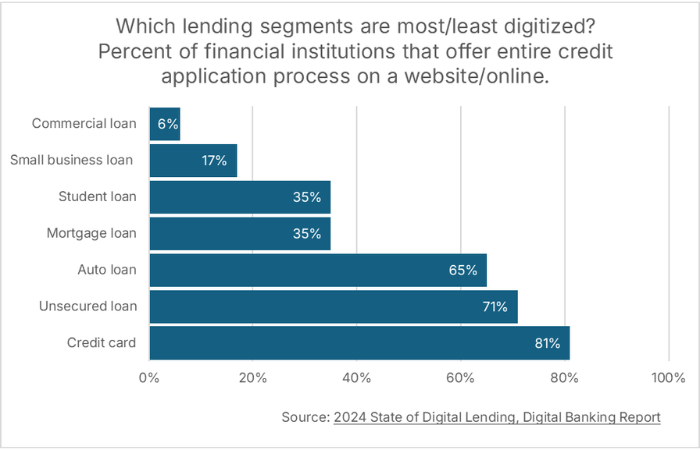
A: Across all product types, nearly 90% of financial institutions make available online/web applications for credit, an increase from 76% in 2019, according to Digital Banking Report’s 2024 State of Digital Lending study. However, most potential borrowers can complete only a portion of the entire credit application process online. That’s especially the case for business or commercial loans, student loans, and mortgages. Small business and commercial lending processes are the least digitized, and credit cards and unsecured personal loans are the most, according to the study.

bar chart showing how lending segments are digitized

Q: What parts of the lending process should institutions digitize first, and what benefits will they see?

A: Focus on three areas:

1. Information collection: Clarify requirements upfront, reduce borrower frustration, and prevent delays from incomplete files. Online applications create a single data source and reduce the risk of errors from rekeying data. Financial packages update automatically as data is added, and staff don’t spend as much time emailing and calling for incomplete loan applications. Once the borrower signals with a completed file that they are ready to move forward with the application, the processing and underwriting can proceed more efficiently.

2. Workflows: Digital lending software that utilizes configurable workflows means all information related to a borrower can be seen in one centralized place, and the steps of a decision can be documented for improved audit tracking. Connecting multiple data sources into a single interface enables loan processors or analysts to import information from third parties, such as credit bureaus, insurance firms, appraisal firms, and other financial institutions. This reduces errors and extra work, speeding up the decision-making process.

3. Analytics and intelligence: Standardize calculations and analyses to improve consistency and reliability across lenders, underwriting teams, and branches. A digital platform can analyze, price, and recommend loan decisions more quickly while generating portfolio insights that support better risk understanding and strategic decisions. Management and boards can more easily see concentration risk and growth opportunities.

Q: How does digital lending improve the borrower experience and help institutions grow without adding staff?

A: Digitization speeds up decisions, increases transparency about requirements and timelines, and reduces rework from errors or missing documents, directly improving the borrower or member experience. For example, Abrigo’s AI-powered Lending Assistant generates credit narratives 25% faster, validates documents, and extracts key data from unstructured files. For the institution, efficiency gains translate into lower operating costs, better profitability, and the capacity to close more loans and increase revenue per loan. This fosters growth in loan portfolios without proportionally increasing staff or risk, and can free resources to enhance service or help contain fees and rates.

Q: Does digital lending replace the relationship lender in many community banks and credit unions?

A: No. Automating time-consuming lending processes, such as document collection and financial spreading, does not replace the lender’s relationship. Instead, it allows staff who normally handle those tasks to direct their time to talking with the customer or member and other staff about needs and which products serve them best. They can also spend more time educating applicants on the credit process and how borrowers can improve their chances of loan approval. In addition, some business borrowers prefer to begin applying in person. For example, Academy Bank’s recent survey of more than 200 entrepreneurs found that more than half applied for loans in a branch, and those working with a dedicated business banker reported positive experiences. However, the survey found a digital-first mindset among younger generations. More than half of Gen Z business owners and 43% of Millennials prefer digital banking options—whether it’s applying online, using mobile tools, or managing their accounts virtually. 

Q: What's the role of AI (artificial intelligence) in digital lending? 

A: AI is transforming digital lending, making processes even faster and less burdensome for busy lenders and credit analysts. For example, Abrigo's AI-powered banking agent, AskAbrigo, is integrated with the loan origination system. Instead of lenders searching through scattered loan files, emails, and policy documents on SharePoint to prepare for a prospect meeting, AskAbrigo can create a comprehensive relationship summary (loans, deposits, ticklers, covenants, guarantors, potential concerns, topics to discuss) from the institution's own data and files, then create a calendar activity and link a summary that can be used to guide the conversation. Early users report saving anywhere from 30 minutes to 5 hours a week on various use cases.


Helping more borrowers get answers quickly

Innovations in digital lending will continue as financial institutions seek additional ways to serve their customers or members while protecting the safety and soundness of the institution. Technology enables an institution to infuse more of its unique banking expertise into workflows, thereby retaining its relationship-driven advantages and preserving community lending. 

Find out how Abrigo Lending Assistant creates credit narratives 25% faster.

Abrigo Lending Assistant

Expanding member business lending can help credit unions better serve small businesses and strengthen relationships, but outdated processes and policies can limit the experience members receive. Programs designed for smaller business loans help credit unions deliver faster decisions, simpler requirements, and experiences that exceed member expectations.

This practical guide takes a “do this, not that” approach to help credit unions design member business lending programs that are efficient, consistent, and member-centric without compromising risk management.

Learn how to:

Discover how Tennessee Valley FCU sped up business loan decisions

The basics of CUSO partnerships for credit unions

Here’s how forward-thinking credit unions can expand their member business lending with CUSOs by aligning strategy, structure, and compliance with long-term goals.

How CUSOs can improve processes and help grow member business lending

Each year, credit unions deliver significant savings to members through lower interest rates on loans. Member business lending (MBL), however, brings a distinct set of challenges. Whether your credit union is seeking to scale its technology, diversify income streams, or expand product offerings, one increasingly viable and sustainable path forward is to partner with credit union service organizations (CUSOs).

CUSOs provide credit unions with a cost-effective, and innovation-friendly model for growing the MBL portfolio. They allow institutions to preserve their member-first identity while remaining agile in a competitive market.

You might also like this webinar, Mitigating Top MBL Risks.

Download now

The case for CUSO collaboration

CUSOs are uniquely structured entities that are owned by credit unions and exist to provide services that might otherwise be too expensive or complex to develop in-house. Under NCUA regulations, federal credit unions can invest in or loan to CUSOs that primarily serve credit unions and are limited to approved activities such as loan origination, technology services, and financial counseling.

By engaging in collaborative ventures like CUSOs, credit unions can reduce duplication of services and achieve operational efficiencies that directly benefit members.

Credit unions are leveraging CUSOs for a variety of strategic purposes. Some partner with lending-focused CUSOs to expand into new verticals like commercial or indirect lending. Others outsource technology, compliance, or data analytics functions to CUSOs, reducing operational overhead while maintaining control over the member experience. Many CUSOs also offer consultative training to help internal staff become more comfortable with business lending practices.

CUSOs are particularly useful for smaller institutions that might struggle to afford or implement advanced solutions independently. Rather than build a loan origination platform or fraud detection system in-house, for example, a credit union can invest in a CUSO that offers the service and immediately bring the benefits to their members.


Aligning CUSO strategy with your credit union’s goals

A successful CUSO strategy starts with clarity. Before making any investment or partnership decisions, credit unions should define their objectives. The end goal might be to offer a smoother member business lending experience, enhance noninterest income, improve digital capabilities, or deliver new products like insurance or wealth management.

Credit unions that partner with CUSOs often begin by identifying gaps in their current service delivery or areas where member demand exceeds institutional capacity. The next step is selecting or forming a CUSO that complements those needs. Next, determine if the scope of the relationship will be ownership, partnership, or full acquisition.

Legal structure, compliance implications, and governance responsibilities should all be considered. According to the NCUA, CUSOs must maintain independent financial records and provide annual reports to both the NCUA and state supervisory authorities if they are federally insured. Ensuring your institution’s internal oversight keeps pace with the partnership is essential for long-term success.


Funding and risk oversight

Investment in a CUSO requires thorough due diligence and financial modeling. Institutions looking to grow with CUSOs should develop clear financial projections, understand expected return timelines, and evaluate the impact on balance sheet strength.

Ongoing risk oversight is also key. The NCUA emphasizes that credit unions must monitor CUSO activities to ensure safety and soundness are not compromised. Even minority ownership stakes can pose reputational or regulatory risk if a CUSO fails to meet compliance expectations. To mitigate this, credit unions should implement periodic reviews, audit procedures, and performance benchmarks for any CUSO relationship.

Grow with CUSOs: A scalable model for the future

By choosing to grow with CUSOs, credit unions gain access to industry expertise, advanced technology, and scalable service models that align with both growth and member impact. And because CUSOs are built on collaboration and shared success, they represent the kind of values-driven innovation the credit union movement was founded on.

Whether you’re seeking to expand your loan portfolio, enhance digital experiences, or boost operational efficiency, now is the time to explore how your institution can grow with CUSOs.


FAQs

What is a Credit Union Service Organization (CUSO) in member business lending?

A Credit Union Service Organization (CUSO) is a separate entity owned by one or more credit unions that provides specialized services, including support for member business lending (MBL). In commercial lending, a CUSO can offer underwriting expertise, servicing support, and operational infrastructure. This model helps credit unions expand MBL capabilities without building a full in-house team.

How can a CUSO help expand a credit union’s MBL portfolio?

A CUSO helps expand an MBL portfolio by providing access to experienced underwriters, standardized processes, and shared risk management practices. This allows credit unions to originate and manage more complex commercial loans while maintaining compliance with NCUA expectations. Leveraging a CUSO reduces ramp-up time and operational strain.

What are the benefits of using a CUSO for commercial lending?

Using a CUSO for commercial lending provides scale, expertise, and operational efficiency. Credit unions can diversify their loan portfolios, compete more effectively in local markets, and improve risk oversight. The CUSO structure also supports collaboration and shared best practices across participating institutions.

What risks should credit unions consider when partnering with a CUSO?

Credit unions should evaluate governance structure, underwriting standards, risk-sharing agreements, and portfolio concentration limits before partnering with a CUSO. Clear oversight and reporting are essential to ensure alignment with the credit union’s risk appetite and regulatory requirements. Strong credit risk management processes remain critical.

How does technology support MBL growth through a CUSO?

Lending technology centralizes underwriting, documentation, portfolio monitoring, and reporting across participating credit unions. Commercial lending software for credit unions improves visibility, supports consistent credit analysis, and strengthens audit readiness. Integrated systems also help manage participation loans and track ongoing credit performance.

Lending strategy for credit unions 

Member business lending is growing again at credit unions, driven by improved liquidity and renewed demand from small businesses. But as portfolios expand and average loan sizes increase, rising delinquencies signal that risk management must keep pace with origination. In 2026, successful member business lending will depend on disciplined portfolio oversight, strategic partnerships, and a long-term view of member needs.

The state of credit union business lending

Member business lending has long played a critical role in how credit unions support small businesses and local communities. However, credit union member business lending has historically been constrained by regulation, most notably the lending caps established under the 1998 Credit Union Membership Access Act and related NCUA rules. These limits have shaped the scale, structure, and growth strategies of member business lending programs for decades.

Despite these constraints, demand for member business lending has remained consistent. According to the Federal Reserve’s Small Business Credit Survey, approximately 7% of small business credit applicants have sought loans, lines of credit, or cash advances from credit unions each year since 2019, demonstrating steady interest in credit union–based member business lending options.

More importantly, credit unions are competitive when they participate in member business lending. SBCS data shows that in 2023, credit union approval rates for business loans, lines of credit, and cash advances were comparable to small banks and traditional nonbank lenders, with 51% of applicants fully approved and 24% partially approved. The success factor lies in how member business lending programs are structured, staffed, and managed over time.

Embrace AI in your credit union's workflows with confidence.

Find resources

Speed and risk management are pain points to successful SMB loans

The MBL cap limits the amount of business loans a credit union can make, but for some credit unions, the restriction has also become a barrier to entry. Due to this cap, some credit unions are hesitant to invest time and resources in establishing small business loan programs.

To be successful in business lending, it’s essential for credit unions to focus on areas where they have control: processes. Digitizing and automating the business lending process allows for credit unions to drastically improve time- and cost-savings. From online loan applications to automated loan decisioning, today’s technology enables credit unions to make lending decisions quickly and support greater loan volumes.

If all loans require the same amount of time – regardless of size – your credit union has little incentive to make small-business loans. For some credit unions, a $20,000 loan and a $2,000,000 loan may go through largely the same origination process, resulting in the cost to originate the loan outweighing the benefit. Technology enables credit unions to streamline their lending process by electronically processing tax returns, reducing and eliminating manual data entry, and automatically scoring and decisioning loans, among other benefits. Business loans can be some of the most paperwork-intensive loans offered, and these technologies enable credit unions to scale business loans, making them profitable investments for their members. 

Risk management's role

Smooth origination is only one part of successful member business lending. Managing a member business lending portfolio through economic cycles, interest rate changes, and borrower stress is significantly more complex.

During the late 2010s and early 2020s, many credit unions benefited from historically low interest rates and exceptionally low delinquencies across their member business lending portfolios. According to the NCUA, delinquency rates at federally insured credit unions reached multi-decade lows during this period.

That environment has shifted. In 2025, member business lending activity rebounded, but early signs of credit stress began to emerge. NCUA quarterly data show that while loan balances increased year over year, delinquency rates also rose, indicating a more normalized credit cycle. For credit unions, this means member business lending success now depends as much on monitoring, analytics, and new tools for proactive risk management as it does on origination volume.

Volumes are back

After a challenging period marked by liquidity pressure and muted demand, member business lending volumes increased in 2025. NCUA data shows that total loans outstanding at federally insured credit unions grew year over year in both the first and second quarters of 2025, reflecting a broad rebound in lending activity, including member business loans.

However, growth within member business lending has been uneven. Industry data suggests that loan dollar volume has grown faster than loan counts, indicating a shift toward larger average member business loan sizes—often tied to commercial real estate. This trend increases concentration risk within member business lending portfolios and reinforces the need for disciplined oversight.

SBA loans as a growth track

Credit unions that want to expand their business lending opportunities and support local businesses and entrepreneurs may consider participating in the Small Business Administration (SBA) loan program.

Loans guaranteed by the U.S. Small Business Administration provide incentives for institutions to lend money to businesses that might not otherwise qualify for term loans. These loans help to bolster local economies by providing capital to small businesses and entrepreneurs. But SBA loans aren’t a magic bullet for business lending. Many financial institutions shy away from SBA loans, due to their reputation of being onerous, complex, and expensive.

To mitigate some of the complexities involved with SBA lending, credit unions can leverage SBA lending technology to help customize and streamline the underwriting and decisioning process for SBA loan application, as well as integrate FRANdata technology, which transfers all franchisor data and eliminates hours of research into franchisees or gambling on the performance of the franchise.

Participations are up, but so are credit quality pressures

Loan participations have re-emerged as a strategic lever within member business lending. After slowing during the liquidity crunch of 2022–2023, participation activity increased alongside improved balance-sheet conditions.

NCUA call report data shows that loan participation balances rose in 2024 and continued to increase in 2025, signaling renewed cooperation among credit unions engaged in member business lending. Institutions without the staffing or infrastructure to originate member business loans at scale are increasingly using participations to meet portfolio goals while managing concentration and regulatory limits.

When used strategically, loan participations can help credit unions expand member business lending capacity, diversify risk, and maintain consistent production without overextending internal teams.

Credit quality trends also deserve close attention. NCUA data shows that the delinquency rate for federally insured credit unions increased year over year in 2025, reaching 0.91% in the second quarter. While still manageable, rising delinquency levels signal increasing stress within loan portfolios—including member business lending portfolios.

Effective member business lending management requires early detection and intervention. Monitoring borrower behavior, property tax performance, and collateral conditions—essentials of effective risk grading—remains essential. In some cases, managing stressed member business loans may require outside expertise, as workouts and collections demand a different skill set than origination.

The future of member business lending

Member business lending has consistently been one of the most impactful ways credit unions serve their communities. As portfolios grow larger and more complex, credit unions must invest in member business lending infrastructure with the same rigor applied to origination growth.

This includes staffing, technology, analytics, and partnerships that support long-term portfolio health. Demand is also evolving. Many businesses formed during the pandemic years are now maturing and seeking more sophisticated financial services—ranging from SBA loans to working capital lines of credit and treasury management.

The current environment offers credit unions a timely opportunity to reset their member business lending programs for sustainable success

FAQs

What is member business lending (MBL)?

Member business lending refers to loans issued by credit unions to businesses owned by their members. These loans support commercial activities such as real estate development, equipment purchases, and working capital needs. Commercial lending software helps credit unions manage underwriting, documentation, and portfolio monitoring.

Why is member business lending important for credit union growth?

MBL programs can diversify revenue streams and strengthen relationships with local businesses. They also help credit unions expand beyond consumer lending. Lending software for credit unions supports scalable underwriting and portfolio oversight as MBL programs grow.

What challenges do credit unions face when expanding member business lending?

Common challenges include limited internal expertise, operational complexity, regulatory requirements, and credit risk management. Scaling commercial lending processes manually can slow growth. Commercial lending management software centralizes underwriting and documentation workflows.

How can credit unions safely expand their MBL programs?

Credit unions can expand safely by establishing clear credit policies, monitoring concentrations, and strengthening risk rating systems. Portfolio analytics help identify emerging risks. Credit risk management software provides dashboards and reporting to support oversight.

How does technology improve efficiency in member business lending?

Technology improves efficiency by automating financial spreading, credit memo preparation, and loan approval workflows. This reduces manual data entry and speeds up underwriting decisions. Commercial lending software helps credit unions manage larger portfolios without increasing operational risk.

Smarter decisions, scalable processes. Learn how to streamline your loan origination process.

Talk to an expert
  • This Abrigo article was originally published December 24, 2025 on CUInsight.com.
A panel of experts from top regulatory supervisory agencies compiled 10 AML hot topics to look out for in 2022

Tips on credit union fraud strategy in 2026

Fraud in credit unions is becoming increasingly complex, costly, and challenging to contain. From synthetic identity fraud to real-time payment risks, today’s fraud challenges go beyond account takeovers and check scams

Protecting members and reducing institutional risk

According to the Federal Trade Commission (FTC), financial institutions reported fraud losses of over $12.5 billion in 2024, a 25% increase over the previous year. Statistics show that even though the financial institution is not at fault, victims of fraud are 31% more likely to end their relationship with the institution.

Heading into 2026, credit unions face a growing list of threats that demand attention. Fortunately, with proactive planning and targeted investments in people, processes, and technology, institutions can continue to protect members while strengthening their culture of compliance.

Staying on top of fraud is a full-time job. Let our Advisory Services team help when you need it.

Connect with an expert

Fraud tactics are evolving

Credit unions are now seeing traditional fraud schemes, such as social engineering, identity theft, and account takeovers, reemerging in new forms, enhanced by increasingly accessible technology. While the methods may look different, the objectives of fraudsters remain unchanged: gain unauthorized access and move funds before detection.

To maintain a strong fraud program in 2026, it’s essential to recognize how these familiar schemes are evolving:

  • Synthetic identity fraud is getting harder to spot as criminals use advanced tools to create fake profiles that look real and pass through normal verification checks.
  • Voice cloning and AI-generated speech are being used in call center fraud, enabling impersonators to bypass authentication by mimicking members’ voices with alarming accuracy.
  • Deepfake video scams have emerged with fraudsters using video messages authorizing transactions that appear to originate from executives or business owners.
  • Mule account activity is accelerating, with fraudsters utilizing instant payment platforms to transfer money through multiple accounts at a faster rate than ever before.

Real-time payment scams

As credit unions expand their use of real-time payments in 2026, it’s essential to acknowledge that faster transactions can also lead to increased fraud. Transactions clear almost instantly, leaving little time to investigate or reverse unauthorized activity.

Two scams, in particular, continue to raise concern among financial institutions.

  • Push payment fraud, also known as authorized payment fraud, occurs when a fraudster tricks a member into willingly sending money to an account the criminal controls. Often, the scam involves creating a sense of urgency, such as pretending to be a relative in distress or a company demanding immediate payment. Because the member “authorized” the transfer, recovering the funds is more difficult.
  • Business email compromise (BEC) remains a critical evolving threat. In these cases, fraudsters impersonate senior executives or vendors, often using compromised or spoofed email addresses, to request urgent wire transfers or payments. These messages can appear legitimate and are usually timed during vacations or leadership absences, making them difficult to detect.

Using AI to strengthen fraud detection

Programs that utilize artificial intelligence (AI) are changing how credit unions detect and prevent fraud. When used responsibly, AI can analyze account behavior in real time, flagging out-of-pattern activity and high-risk transactions before losses occur. AI is beneficial for detecting altered check amounts, elder fraud, or fraud schemes tied to organized regional groups.

However, with this innovation comes added responsibility. Regulators are closely monitoring the use of AI tools in financial services to ensure they are ethical, explainable, and free from bias. Members, too, want reassurance that their data is protected and that automation isn’t replacing human judgment. For credit unions, the goal should be to use AI to enhance, not replace, member service. Institutions that successfully balance automation with a human-in-the-loop approach will be better equipped to serve and protect their communities.


Strengthening internal controls

To address today’s evolving fraud schemes, credit unions don’t need to start from scratch. However, they do need to take a hard look at their existing controls and determine where updates are required. Strengthening foundational practices while adapting to new risks can significantly reduce the likelihood of loss and maintain member trust.

  • Strengthen authentication processes: Traditional knowledge-based authentication is often insufficient in many cases. For high-risk or unusual interactions, consider adding layered verification, such as voice recognition or a second contact method, before approving changes or transactions.
  • Invest in staff training: Your front-line teams are a critical part of your fraud prevention program. Ensure they understand how newer schemes can be used during routine member interactions. Regular training and scenario-based exercises can keep your team prepared.
  • Collaborate with peer institutions: Fraudsters don’t target just one institution. Collaboration with other financial institutions is essential, such as 314(b) information sharing. Sharing information about scam trends, suspicious account activity, and known fraud patterns can help improve response times and better protect members.

Staffing gaps pose a hidden risk

While fraud tactics have evolved, many credit unions still face an internal challenge: staffing. Institutions continue to struggle with hiring and retaining experienced fraud professionals, particularly those who can manage complex investigations or handle alerts tied to instant payments. As workloads increase and expectations rise, this staffing gap can quickly become a liability.

Conducting a formal staffing assessment is a necessary step for credit unions in 2026. Institutions should examine not only their current team capacity but also opportunities for cross-training, succession plans, and contingency coverage. Some may benefit from partnering with third-party advisory teams to fill short-term gaps or offer specialized support during high-risk periods.

Member education is essential

Technology and staffing are only part of the solution. Fraudsters are increasingly bypassing institutions altogether and targeting members directly through phishing emails, spoofed texts, and fake payment requests. Proactive member education is essential.

Credit unions should regularly remind members to be cautious with unsolicited requests, especially those involving urgency or changes to payment information. Encouraging the use of strong passwords, multi-factor authentication, and transaction alerts can help members quickly identify unauthorized activity. Just as importantly, members need clear guidance on how to report suspicious behavior, and reassurance that their credit union is there to support them if something goes wrong.

Internally, institutions should continue to build layered defenses that include behavior-based transaction monitoring, account watchlists, and limits for new or unusual activity. Combined with external education, these steps form a stronger line of defense against fraud.

Looking forward: Build a resilient fraud response

The future of fraud in credit unions brings both challenges and opportunities. New payment rails, growing digital adoption, and evolving scams demand action, but they also present a chance to modernize programs and deepen member trust.

Credit unions that take a comprehensive approach, one that includes real-time detection, thoughtful AI adoption, strong staffing, and member education, will be best positioned to protect both their institutions and the communities they serve. Fraud prevention isn’t just about technology or rules. It’s about creating a program that evolves alongside the threats, without losing sight of what makes credit unions unique: their relationships.

FAQs

What are the top fraud threats facing credit unions in 2026?


Top fraud threats in 2026 include synthetic ID/account opening fraud, payments and ACH fraud, account takeover, and social-engineering scams. Fraud detection software for credit unions that uses transaction analytics and identity signals helps detect these evolving typologies early and reduce losses while preserving member trust.

How can credit unions detect fraud faster without disrupting members?

Detect fraud faster by combining real-time analytics, behavioral profiling, and risk scoring into an integrated fraud detection platform. Fraud prevention for credit unions uses configurable rules plus machine learning to prioritize high-risk alerts, reduce false positives, and automate case routing—maintaining smooth member experience.

What role does member education play in fraud mitigation?

Member education reduces susceptibility to social-engineering and phishing, making it a low-cost complement to technology. Pair consumer outreach with fraud detection software for credit unions so suspicious activity flagged by analytics is less likely to succeed if members are already informed and suspicious behaviors are reported quickly.

How should credit unions balance automation and investigator review?

Balance automation and human review by using automated triage to surface high-value alerts and preserve investigator capacity for complex cases. Fraud detection and case-management software centralizes alerts, evidence, and disposition workflows so investigators focus on decisions that require judgment while routine matches are handled automatically.

What operational controls strengthen a credit union’s fraud program?

Strong controls include real-time monitoring, tiered risk scoring, documented investigation workflows, timely member notifications, and robust audit trails. Fraud prevention software for credit unions centralizes these controls—improving scalability, regulatory defensibility, and coordinated response across fraud, compliance, and operations teams.

Find out how Abrigo Fraud Detection stops check fraud in its tracks.

Learn more

Launching or expanding small business lending offers credit unions powerful opportunities to strengthen member relationships and diversify portfolios—but it also introduces new risks and regulatory scrutiny.

This guide outlines seven practical strategies to help credit unions confidently grow their small business lending programs while managing risk effectively. From defining risk appetite and setting concentration limits to monitoring leading indicators and adopting consistent charge-off policies, these proactive steps can position your institution for sustainable growth.

Learn how to:

Credit unions must identify, report, and monitor policy exceptions as part of strong risk management. Yet many institutions track too many “exceptions,” creating noise that hides real credit risk.

This checklist helps credit unions refine their approach by defining what truly qualifies as an exception—and how to manage it effectively. It outlines five practical steps to improve clarity, accountability, and compliance across commercial and member business lending.

Learn how to: