



The impact is significant. According to the FBI’s Internet Crime Complaint Center (IC3), seniors lost $7.75 billion in 2025, and losses continue to rise. Financial institutions are seeing a shift in which AI is increasingly used to enhance fraud schemes, while human manipulation remains at the core. Bad actors are blending advanced tools with careful research and patience to exploit trust. AI-driven elder fraud is now both a technology challenge and a relationship challenge, requiring institutions to respond with equal parts innovation and awareness.
Elder Fraud in the age of artificial intelligence
As artificial intelligence (AI) evolves, fraudsters are using it to refine their targeting of older adults. Scams that once required time and effort can now be executed faster, at greater scale, and with convincing detail.
This article covers these key topics:
The evolving tactics behind elder financial exploitation
Fraud schemes targeting seniors are not new. Phishing attempts, romance scams, and investment fraud have existed for years. What has changed is the level of sophistication and personalization.
Fraudsters are now using generative AI tools such as voice cloning and deepfakes to make their outreach more believable. A deepfake can replicate a person’s voice, image, or video in a way that feels authentic, even to someone who knows the individual well. Criminals often gather details from social media or other public sources, studying their targets before making contact.
Need help fighting fraud?
Learn moreThis preparation is important to understand. While AI accelerates execution, bad actors are still doing their homework. They learn family names, travel plans, and communication styles. They understand how a grandchild speaks to a grandparent or how a trusted contact might phrase a request. That human intelligence, combined with AI, creates a powerful and dangerous mix.
Social engineering tactics remain highly effective. Romance scams, in particular, continue to be widely used because they rely on building emotional connections over time. These fraudsters are patient. They invest weeks or months in building trust before making a financial request. AI may help scale their efforts, but success still comes from manipulation rooted in human behavior.
Consider an AI-enhanced grandparent scam. A fraudster reviews a grandchild’s social media, noting a trip abroad and a nickname like “Nana.” Using voice cloning, they place a call that sounds like the grandchild in distress, asking for urgent help with bail money. The voice's realism, combined with accurate personal details, creates a sense of urgency that can override caution.
What once might have raised suspicion now feels credible. That shift is what makes AI-driven elder fraud particularly challenging to detect.
What financial institutions can do to fight elder fraud
Financial institutions play a critical role in protecting older adults. The combination of technology, staff awareness, and strong customer relationships remains the most effective defense.
Robust fraud detection systems should be configured to identify unusual activity, especially for accounts held by older clients. Monitoring for sudden wire transfers, atypical withdrawal patterns, or new payees can help flag potential fraud early. Tailoring these parameters to customer behavior improves detection and response times.
Equally important is ongoing staff training. Front-line employees and fraud teams need to recognize the signs of both AI-driven scams and traditional social engineering. Customers who appear anxious, confused, or unusually secretive during transactions may be under pressure. Training should focus not only on identifying red flags but also on responding with empathy and clarity.
Clear communication protocols also matter. Reinforcing that the institution will never request sensitive information through unsolicited calls, emails, or texts helps set expectations. This becomes even more critical as AI-generated messages and voice calls become harder to distinguish from legitimate ones.
Strong customer relationships remain one of the most effective tools. A simple conversation can uncover concerns that technology alone might miss. When staff feel comfortable asking questions about unusual transactions, they create opportunities to pause and verify before releasing funds from the account.
Understanding regulatory expectations
Regulators continue to emphasize the importance of detecting and reporting elder financial abuse. Fraud remains a national priority, and institutions are expected to adapt as threats evolve.
Filing suspicious activity reports is only one part of the response. Institutions must demonstrate a broader culture of vigilance, supported by training, staffing, and effective processes. FinCEN has emphasized that adequate staffing and resources are critical to maintaining an effective AML/CFT program, including timely detection and reporting of suspicious activity.
Collaboration between fraud and anti-money laundering teams is increasingly important. Complex fraud schemes do not fit neatly into one category, and siloed approaches can slow detection. Integrating insights across teams allows institutions to respond more effectively to emerging threats.
Community education
Technology alone will not solve this challenge. Many cases of elder fraud can be prevented through consistent and practical education. Hosting in-person sessions at branches, senior centers, or community organizations provides an opportunity to explain how modern scams work. Demonstrating how AI can replicate voices or create realistic messages helps make the risk more tangible.
Partnerships with local law enforcement or community groups can extend reach and reinforce credibility. Printed materials, short videos, and account alerts can also help keep fraud prevention top of mind between interactions.
Education works best when it is ongoing. A single conversation may not be enough, but consistent messaging builds awareness and confidence over time.
Practical tips
Simple, actionable guidance can help seniors protect themselves from increasingly sophisticated fraud attempts. Encourage clients to verify unexpected requests by contacting the person or organization using a known, trusted number. Remind them to be cautious with urgent messages, especially those that involve pressure to act quickly.
Account alerts can provide early warning signs of unusual activity, allowing for faster intervention. Regularly reviewing account statements or involving a trusted family member can add another layer of oversight.
Clear, straightforward communication is key. When clients understand what to watch for and how to respond, they are better equipped to avoid becoming victims.
Protecting seniors in a rapidly changing fraud environment
AI has changed the speed and scale of fraud, but it has not replaced the human element. In many ways, it has amplified it. Fraudsters are pairing advanced technology with deliberate research and well-practiced manipulation tactics that have proven effective for years. For financial institutions, the path forward is not about choosing between technology and human insight. It is about strengthening both.
By investing in fraud detection, prioritizing staff training, and maintaining strong relationships with customers, institutions can better protect older adults and reinforce trust in their communities. Staying proactive today is essential to managing the risks of tomorrow.
FAQs
What is elder fraud detection software for banks and credit unions?
Elder fraud detection software helps financial institutions identify suspicious transactions and behavioral red flags that may signal financial exploitation of older adults. In this context, Abrigo’s fraud detection approach combines transaction monitoring, staff awareness, and customer insight to help banks and credit unions respond earlier to AI-enhanced scams
Why is elder fraud harder to detect in the age of AI?
Elder fraud is harder to detect because fraudsters now use generative AI, voice cloning, and deepfakes to make scams more believable and more personal. The article explains that AI increases scale and realism, but the fraud still succeeds through human manipulation, emotional pressure, and careful research.
How does fraud detection software help prevent elder financial exploitation?
Fraud detection software helps prevent elder financial exploitation by flagging unusual account activity such as sudden wires, atypical withdrawals, or new payees. Abrigo’s fraud detection framing also stresses configuring alerts around customer behavior so institutions can investigate faster and intervene before funds leave the account
What should banks monitor for possible elder fraud?
Banks should monitor for transaction patterns that fall outside a customer’s normal behavior, including sudden wire transfers, unusual withdrawals, and newly added payees. The article also points to behavioral warning signs during transactions, such as anxiety, confusion, or secrecy, which means detection should combine software and staff observation.
Why does human insight still matter in fraud detection software?
{"type":"elementor","siteurl":"https://www.abrigo.com/wp-json/","elements":[{"id":"3cb5cfb0","elType":"widget","isInner":false,"isLocked":false,"settings":{"content":"**Find out how Abrigo Fraud Detection stops check fraud in its tracks.**","bgcolor":"#F8F8F8","button-text":"Fraud detection software","button-url":{"url":"https://www.abrigo.com/software/bsa-aml-and-fraud/fraud-detection/","is_external":"","nofollow":"","custom_attributes":""},"button-color":"#00C2D1","button2-text":"Keep me informed","button2-color":"#383943","__globals__":{"button2-color":"","bgcolor":"","button-color":""},"type":"full","heading_tag":"h2","description":"","button-title":"","button2-url":{"url":"","is_external":"","nofollow":"","custom_attributes":""},"button2-title":"","anchor":"","_title":"","_margin":{"unit":"px","top":"","right":"","bottom":"","left":"","isLinked":true},"_margin_tablet":{"unit":"px","top":"","right":"","bottom":"","left":"","isLinked":true},"_margin_mobile":{"unit":"px","top":"","right":"","bottom":"","left":"","isLinked":true},"_padding":{"unit":"px","top":"","right":"","bottom":"","left":"","isLinked":true},"_padding_tablet":{"unit":"px","top":"","right":"","bottom":"","left":"","isLinked":true},"_padding_mobile":{"unit":"px","top":"","right":"","bottom":"","left":"","isLinked":true},"_element_width":"","_element_width_tablet":"","_element_width_mobile":"","_element_custom_width":{"unit":"%","size":"","sizes":[]},"_element_custom_width_tablet":{"unit":"px","size":"","sizes":[]},"_element_custom_width_mobile":{"unit":"px","size":"","sizes":[]},"_grid_column":"","_grid_column_tablet":"","_grid_column_mobile":"","_grid_column_custom":"","_grid_column_custom_tablet":"","_grid_column_custom_mobile":"","_grid_row":"","_grid_row_tablet":"","_grid_row_mobile":"","_grid_row_custom":"","_grid_row_custom_tablet":"","_grid_row_custom_mobile":"","_element_vertical_align":"","_element_vertical_align_tablet":"","_element_vertical_align_mobile":"","_position":"","_offset_orientation_h":"start","_offset_x":{"unit":"px","size":0,"sizes":[]},"_offset_x_tablet":{"unit":"px","size":"","sizes":[]},"_offset_x_mobile":{"unit":"px","size":"","sizes":[]},"_offset_x_end":{"unit":"px","size":0,"sizes":[]},"_offset_x_end_tablet":{"unit":"px","size":"","sizes":[]},"_offset_x_end_mobile":{"unit":"px","size":"","sizes":[]},"_offset_orientation_v":"start","_offset_y":{"unit":"px","size":0,"sizes":[]},"_offset_y_tablet":{"unit":"px","size":"","sizes":[]},"_offset_y_mobile":{"unit":"px","size":"","sizes":[]},"_offset_y_end":{"unit":"px","size":0,"sizes":[]},"_offset_y_end_tablet":{"unit":"px","size":"","sizes":[]},"_offset_y_end_mobile":{"unit":"px","size":"","sizes":[]},"_z_index":"","_z_index_tablet":"","_z_index_mobile":"","_element_id":"","_css_classes":"","e_display_conditions":"","_element_cache":"","motion_fx_motion_fx_scrolling":"","motion_fx_translateY_effect":"","motion_fx_translateY_direction":"","motion_fx_translateY_speed":{"unit":"px","size":4,"sizes":[]},"motion_fx_translateY_affectedRange":{"unit":"%","size":"","sizes":{"start":0,"end":100}},"motion_fx_translateX_effect":"","motion_fx_translateX_direction":"","motion_fx_translateX_speed":{"unit":"px","size":4,"sizes":[]},"motion_fx_translateX_affectedRange":{"unit":"%","size":"","sizes":{"start":0,"end":100}},"motion_fx_opacity_effect":"","motion_fx_opacity_direction":"out-in","motion_fx_opacity_level":{"unit":"px","size":10,"sizes":[]},"motion_fx_opacity_range":{"unit":"%","size":"","sizes":{"start":20,"end":80}},"motion_fx_blur_effect":"","motion_fx_blur_direction":"out-in","motion_fx_blur_level":{"unit":"px","size":7,"sizes":[]},"motion_fx_blur_range":{"unit":"%","size":"","sizes":{"start":20,"end":80}},"motion_fx_rotateZ_effect":"","motion_fx_rotateZ_direction":"","motion_fx_rotateZ_speed":{"unit":"px","size":1,"sizes":[]},"motion_fx_rotateZ_affectedRange":{"unit":"%","size":"","sizes":{"start":0,"end":100}},"motion_fx_scale_effect":"","motion_fx_scale_direction":"out-in","motion_fx_scale_speed":{"unit":"px","size":4,"sizes":[]},"motion_fx_scale_range":{"unit":"%","size":"","sizes":{"start":20,"end":80}},"motion_fx_transform_origin_x":"center","motion_fx_transform_origin_y":"center","motion_fx_devices":["desktop","tablet","mobile"],"motion_fx_range":"","motion_fx_motion_fx_mouse":"","motion_fx_mouseTrack_effect":"","motion_fx_mouseTrack_direction":"","motion_fx_mouseTrack_speed":{"unit":"px","size":1,"sizes":[]},"motion_fx_tilt_effect":"","motion_fx_tilt_direction":"","motion_fx_tilt_speed":{"unit":"px","size":4,"sizes":[]},"handle_motion_fx_asset_loading":"","sticky":"","sticky_on":["desktop","tablet","mobile"],"sticky_offset":0,"sticky_offset_tablet":"","sticky_offset_mobile":"","sticky_effects_offset":0,"sticky_effects_offset_tablet":"","sticky_effects_offset_mobile":"","sticky_anchor_link_offset":0,"sticky_anchor_link_offset_tablet":"","sticky_anchor_link_offset_mobile":"","sticky_parent":"","_animation":"","_animation_tablet":"","_animation_mobile":"","animation_duration":"","_animation_delay":"","_transform_rotate_popover":"","_transform_rotateZ_effect":{"unit":"px","size":"","sizes":[]},"_transform_rotateZ_effect_tablet":{"unit":"deg","size":"","sizes":[]},"_transform_rotateZ_effect_mobile":{"unit":"deg","size":"","sizes":[]},"_transform_rotate_3d":"","_transform_rotateX_effect":{"unit":"px","size":"","sizes":[]},"_transform_rotateX_effect_tablet":{"unit":"deg","size":"","sizes":[]},"_transform_rotateX_effect_mobile":{"unit":"deg","size":"","sizes":[]},"_transform_rotateY_effect":{"unit":"px","size":"","sizes":[]},"_transform_rotateY_effect_tablet":{"unit":"deg","size":"","sizes":[]},"_transform_rotateY_effect_mobile":{"unit":"deg","size":"","sizes":[]},"_transform_perspective_effect":{"unit":"px","size":"","sizes":[]},"_transform_perspective_effect_tablet":{"unit":"px","size":"","sizes":[]},"_transform_perspective_effect_mobile":{"unit":"px","size":"","sizes":[]},"_transform_translate_popover":"","_transform_translateX_effect":{"unit":"px","size":"","sizes":[]},"_transform_translateX_effect_tablet":{"unit":"px","size":"","sizes":[]},"_transform_translateX_effect_mobile":{"unit":"px","size":"","sizes":[]},"_transform_translateY_effect":{"unit":"px","size":"","sizes":[]},"_transform_translateY_effect_tablet":{"unit":"px","size":"","sizes":[]},"_transform_translateY_effect_mobile":{"unit":"px","size":"","sizes":[]},"_transform_scale_popover":"","_transform_keep_proportions":"yes","_transform_scale_effect":{"unit":"px","size":"","sizes":[]},"_transform_scale_effect_tablet":{"unit":"px","size":"","sizes":[]},"_transform_scale_effect_mobile":{"unit":"px","size":"","sizes":[]},"_transform_scaleX_effect":{"unit":"px","size":"","sizes":[]},"_transform_scaleX_effect_tablet":{"unit":"px","size":"","sizes":[]},"_transform_scaleX_effect_mobile":{"unit":"px","size":"","sizes":[]},"_transform_scaleY_effect":{"unit":"px","size":"","sizes":[]},"_transform_scaleY_effect_tablet":{"unit":"px","size":"","sizes":[]},"_transform_scaleY_effect_mobile":{"unit":"px","size":"","sizes":[]},"_transform_skew_popover":"","_transform_skewX_effect":{"unit":"px","size":"","sizes":[]},"_transform_skewX_effect_tablet":{"unit":"deg","size":"","sizes":[]},"_transform_skewX_effect_mobile":{"unit":"deg","size":"","sizes":[]},"_transform_skewY_effect":{"unit":"px","size":"","sizes":[]},"_transform_skewY_effect_tablet":{"unit":"deg","size":"","sizes":[]},"_transform_skewY_effect_mobile":{"unit":"deg","size":"","sizes":[]},"_transform_flipX_effect":"","_transform_flipY_effect":"","_transform_rotate_popover_hover":"","_transform_rotateZ_effect_hover":{"unit":"px","size":"","sizes":[]},"_transform_rotateZ_effect_hover_tablet":{"unit":"deg","size":"","sizes":[]},"_transform_rotateZ_effect_hover_mobile":{"unit":"deg","size":"","sizes":[]},"_transform_rotate_3d_hover":"","_transform_rotateX_effect_hover":{"unit":"px","size":"","sizes":[]},"_transform_rotateX_effect_hover_tablet":{"unit":"deg","size":"","sizes":[]},"_transform_rotateX_effect_hover_mobile":{"unit":"deg","size":"","sizes":[]},"_transform_rotateY_effect_hover":{"unit":"px","size":"","sizes":[]},"_transform_rotateY_effect_hover_tablet":{"unit":"deg","size":"","sizes":[]},"_transform_rotateY_effect_hover_mobile":{"unit":"deg","size":"","sizes":[]},"_transform_perspective_effect_hover":{"unit":"px","size":"","sizes":[]},"_transform_perspective_effect_hover_tablet":{"unit":"px","size":"","sizes":[]},"_transform_perspective_effect_hover_mobile":{"unit":"px","size":"","sizes":[]},"_transform_translate_popover_hover":"","_transform_translateX_effect_hover":{"unit":"px","size":"","sizes":[]},"_transform_translateX_effect_hover_tablet":{"unit":"px","size":"","sizes":[]},"_transform_translateX_effect_hover_mobile":{"unit":"px","size":"","sizes":[]},"_transform_translateY_effect_hover":{"unit":"px","size":"","sizes":[]},"_transform_translateY_effect_hover_tablet":{"unit":"px","size":"","sizes":[]},"_transform_translateY_effect_hover_mobile":{"unit":"px","size":"","sizes":[]},"_transform_scale_popover_hover":"","_transform_keep_proportions_hover":"yes","_transform_scale_effect_hover":{"unit":"px","size":"","sizes":[]},"_transform_scale_effect_hover_tablet":{"unit":"px","size":"","sizes":[]},"_transform_scale_effect_hover_mobile":{"unit":"px","size":"","sizes":[]},"_transform_scaleX_effect_hover":{"unit":"px","size":"","sizes":[]},"_transform_scaleX_effect_hover_tablet":{"unit":"px","size":"","sizes":[]},"_transform_scaleX_effect_hover_mobile":{"unit":"px","size":"","sizes":[]},"_transform_scaleY_effect_hover":{"unit":"px","size":"","sizes":[]},"_transform_scaleY_effect_hover_tablet":{"unit":"px","size":"","sizes":[]},"_transform_scaleY_effect_hover_mobile":{"unit":"px","size":"","sizes":[]},"_transform_skew_popover_hover":"","_transform_skewX_effect_hover":{"unit":"px","size":"","sizes":[]},"_transform_skewX_effect_hover_tablet":{"unit":"deg","size":"","sizes":[]},"_transform_skewX_effect_hover_mobile":{"unit":"deg","size":"","sizes":[]},"_transform_skewY_effect_hover":{"unit":"px","size":"","sizes":[]},"_transform_skewY_effect_hover_tablet":{"unit":"deg","size":"","sizes":[]},"_transform_skewY_effect_hover_mobile":{"unit":"deg","size":"","sizes":[]},"_transform_flipX_effect_hover":"","_transform_flipY_effect_hover":"","_transform_transition_hover":{"unit":"px","size":"","sizes":[]},"motion_fx_transform_x_anchor_point":"","motion_fx_transform_x_anchor_point_tablet":"","motion_fx_transform_x_anchor_point_mobile":"","motion_fx_transform_y_anchor_point":"","motion_fx_transform_y_anchor_point_tablet":"","motion_fx_transform_y_anchor_point_mobile":"","_background_background":"","_background_color":"","_background_color_stop":{"unit":"%","size":0,"sizes":[]},"_background_color_stop_tablet":{"unit":"%"},"_background_color_stop_mobile":{"unit":"%"},"_background_color_b":"#f2295b","_background_color_b_stop":{"unit":"%","size":100,"sizes":[]},"_background_color_b_stop_tablet":{"unit":"%"},"_background_color_b_stop_mobile":{"unit":"%"},"_background_gradient_type":"linear","_background_gradient_angle":{"unit":"deg","size":180,"sizes":[]},"_background_gradient_angle_tablet":{"unit":"deg"},"_background_gradient_angle_mobile":{"unit":"deg"},"_background_gradient_position":"center center","_background_gradient_position_tablet":"","_background_gradient_position_mobile":"","_background_image":{"url":"","id":"","size":""},"_background_image_tablet":{"url":"","id":"","size":""},"_background_image_mobile":{"url":"","id":"","size":""},"_background_position":"","_background_position_tablet":"","_background_position_mobile":"","_background_xpos":{"unit":"px","size":0,"sizes":[]},"_background_xpos_tablet":{"unit":"px","size":0,"sizes":[]},"_background_xpos_mobile":{"unit":"px","size":0,"sizes":[]},"_background_ypos":{"unit":"px","size":0,"sizes":[]},"_background_ypos_tablet":{"unit":"px","size":0,"sizes":[]},"_background_ypos_mobile":{"unit":"px","size":0,"sizes":[]},"_background_attachment":"","_background_repeat":"","_background_repeat_tablet":"","_background_repeat_mobile":"","_background_size":"","_background_size_tablet":"","_background_size_mobile":"","_background_bg_width":{"unit":"%","size":100,"sizes":[]},"_background_bg_width_tablet":{"unit":"px","size":"","sizes":[]},"_background_bg_width_mobile":{"unit":"px","size":"","sizes":[]},"_background_video_link":"","_background_video_start":"","_background_video_end":"","_background_play_once":"","_background_play_on_mobile":"","_background_privacy_mode":"","_background_video_fallback":{"url":"","id":"","size":""},"_background_slideshow_gallery":[],"_background_slideshow_loop":"yes","_background_slideshow_slide_duration":5000,"_background_slideshow_slide_transition":"fade","_background_slideshow_transition_duration":500,"_background_slideshow_background_size":"","_background_slideshow_background_size_tablet":"","_background_slideshow_background_size_mobile":"","_background_slideshow_background_position":"","_background_slideshow_background_position_tablet":"","_background_slideshow_background_position_mobile":"","_background_slideshow_lazyload":"","_background_slideshow_ken_burns":"","_background_slideshow_ken_burns_zoom_direction":"in","_background_hover_background":"","_background_hover_color":"","_background_hover_color_stop":{"unit":"%","size":0,"sizes":[]},"_background_hover_color_stop_tablet":{"unit":"%"},"_background_hover_color_stop_mobile":{"unit":"%"},"_background_hover_color_b":"#f2295b","_background_hover_color_b_stop":{"unit":"%","size":100,"sizes":[]},"_background_hover_color_b_stop_tablet":{"unit":"%"},"_background_hover_color_b_stop_mobile":{"unit":"%"},"_background_hover_gradient_type":"linear","_background_hover_gradient_angle":{"unit":"deg","size":180,"sizes":[]},"_background_hover_gradient_angle_tablet":{"unit":"deg"},"_background_hover_gradient_angle_mobile":{"unit":"deg"},"_background_hover_gradient_position":"center center","_background_hover_gradient_position_tablet":"","_background_hover_gradient_position_mobile":"","_background_hover_image":{"url":"","id":"","size":""},"_background_hover_image_tablet":{"url":"","id":"","size":""},"_background_hover_image_mobile":{"url":"","id":"","size":""},"_background_hover_position":"","_background_hover_position_tablet":"","_background_hover_position_mobile":"","_background_hover_xpos":{"unit":"px","size":0,"sizes":[]},"_background_hover_xpos_tablet":{"unit":"px","size":0,"sizes":[]},"_background_hover_xpos_mobile":{"unit":"px","size":0,"sizes":[]},"_background_hover_ypos":{"unit":"px","size":0,"sizes":[]},"_background_hover_ypos_tablet":{"unit":"px","size":0,"sizes":[]},"_background_hover_ypos_mobile":{"unit":"px","size":0,"sizes":[]},"_background_hover_attachment":"","_background_hover_repeat":"","_background_hover_repeat_tablet":"","_background_hover_repeat_mobile":"","_background_hover_size":"","_background_hover_size_tablet":"","_background_hover_size_mobile":"","_background_hover_bg_width":{"unit":"%","size":100,"sizes":[]},"_background_hover_bg_width_tablet":{"unit":"px","size":"","sizes":[]},"_background_hover_bg_width_mobile":{"unit":"px","size":"","sizes":[]},"_background_hover_video_link":"","_background_hover_video_start":"","_background_hover_video_end":"","_background_hover_play_once":"","_background_hover_play_on_mobile":"","_background_hover_privacy_mode":"","_background_hover_video_fallback":{"url":"","id":"","size":""},"_background_hover_slideshow_gallery":[],"_background_hover_slideshow_loop":"yes","_background_hover_slideshow_slide_duration":5000,"_background_hover_slideshow_slide_transition":"fade","_background_hover_slideshow_transition_duration":500,"_background_hover_slideshow_background_size":"","_background_hover_slideshow_background_size_tablet":"","_background_hover_slideshow_background_size_mobile":"","_background_hover_slideshow_background_position":"","_background_hover_slideshow_background_position_tablet":"","_background_hover_slideshow_background_position_mobile":"","_background_hover_slideshow_lazyload":"","_background_hover_slideshow_ken_burns":"","_background_hover_slideshow_ken_burns_zoom_direction":"in","_background_hover_transition":{"unit":"px","size":"","sizes":[]},"_border_border":"","_border_width":{"unit":"px","top":"","right":"","bottom":"","left":"","isLinked":true},"_border_width_tablet":{"unit":"px","top":"","right":"","bottom":"","left":"","isLinked":true},"_border_width_mobile":{"unit":"px","top":"","right":"","bottom":"","left":"","isLinked":true},"_border_color":"","_border_radius":{"unit":"px","top":"","right":"","bottom":"","left":"","isLinked":true},"_border_radius_tablet":{"unit":"px","top":"","right":"","bottom":"","left":"","isLinked":true},"_border_radius_mobile":{"unit":"px","top":"","right":"","bottom":"","left":"","isLinked":true},"_box_shadow_box_shadow_type":"","_box_shadow_box_shadow":{"horizontal":0,"vertical":0,"blur":10,"spread":0,"color":"rgba(0,0,0,0.5)"},"_box_shadow_box_shadow_position":" ","_border_hover_border":"","_border_hover_width":{"unit":"px","top":"","right":"","bottom":"","left":"","isLinked":true},"_border_hover_width_tablet":{"unit":"px","top":"","right":"","bottom":"","left":"","isLinked":true},"_border_hover_width_mobile":{"unit":"px","top":"","right":"","bottom":"","left":"","isLinked":true},"_border_hover_color":"","_border_radius_hover":{"unit":"px","top":"","right":"","bottom":"","left":"","isLinked":true},"_border_radius_hover_tablet":{"unit":"px","top":"","right":"","bottom":"","left":"","isLinked":true},"_border_radius_hover_mobile":{"unit":"px","top":"","right":"","bottom":"","left":"","isLinked":true},"_box_shadow_hover_box_shadow_type":"","_box_shadow_hover_box_shadow":{"horizontal":0,"vertical":0,"blur":10,"spread":0,"color":"rgba(0,0,0,0.5)"},"_box_shadow_hover_box_shadow_position":" ","_border_hover_transition":{"unit":"px","size":"","sizes":[]},"_mask_switch":"","_mask_shape":"circle","_mask_image":{"url":"","id":"","size":""},"_mask_image_tablet":{"url":"","id":"","size":""},"_mask_image_mobile":{"url":"","id":"","size":""},"_mask_size":"contain","_mask_size_tablet":"","_mask_size_mobile":"","_mask_size_scale":{"unit":"%","size":100,"sizes":[]},"_mask_size_scale_tablet":{"unit":"px","size":"","sizes":[]},"_mask_size_scale_mobile":{"unit":"px","size":"","sizes":[]},"_mask_position":"center center","_mask_position_tablet":"","_mask_position_mobile":"","_mask_position_x":{"unit":"%","size":0,"sizes":[]},"_mask_position_x_tablet":{"unit":"px","size":"","sizes":[]},"_mask_position_x_mobile":{"unit":"px","size":"","sizes":[]},"_mask_position_y":{"unit":"%","size":0,"sizes":[]},"_mask_position_y_tablet":{"unit":"px","size":"","sizes":[]},"_mask_position_y_mobile":{"unit":"px","size":"","sizes":[]},"_mask_repeat":"no-repeat","_mask_repeat_tablet":"","_mask_repeat_mobile":"","hide_desktop":"","hide_tablet":"","hide_mobile":"","_attributes":"","custom_css":""},"defaultEditSettings":{"defaultEditRoute":"content"},"interactions":{},"elements":[],"widgetType":"abo-cta-blocks","htmlCache":"\t\t<div class=\"elementor-widget-container\">\n\t\t\t\t\t\n <div class=\"container container--full-width\">\n <div class=\"cta__background bg--alabaster\"> <div class=\"cta\">\n <h2 class=\"cta__text\"> <strong>Find out how Abrigo Fraud Detection stops check fraud in its tracks.</strong> </h2> <a href=\"https://www.abrigo.com/software/bsa-aml-and-fraud/fraud-detection/\" class=\"button button--robin-egg-blue\" >Fraud detection software</a>\n </div>\n </div> </div>\n \t\t\t\t</div>\n\t\t","editSettings":{"defaultEditRoute":"content","panel":{"activeTab":"content","activeSection":"abo-cta-blocks"}}}]}Human insight still matters because software can surface anomalies, but employees often uncover the context behind an unusual transaction. Abrigo’s article makes the point directly: a conversation with a customer can reveal pressure, confusion, or manipulation that automated monitoring alone may miss.
Find out how Abrigo Fraud Detection stops check fraud in its tracks.
Fraud detection software



Insights to prepare for automation technology
Learn best practices for taking a measured, progress-driven approach to automating your small business lending processes.
Key topics covered in this post:
- Start with segmentation
- Automate the routine
- Use simple decision models
- Roll out changes incrementally
Outline a plan before automating your lending process
Financial institutions looking to grow efficiently know that automating small-business lending saves lenders valuable time and frees them up to focus on relationship building. But the most successful programs take a holistic, data-first approach rather than diving into new technology without a plan.
Insights from a recent industry panel highlight a consistent pattern: institutions that see meaningful gains focus on defining the right segment, automating the right tasks, and expanding only after proving results.
Do more with your small lending team. Explore automated credit and lending processes.
Loan origination softwareStart with segmentation, not automation
Instead of beginning by automating everything, panelists on an Abrigo webinar described defining small-business lending segments based on loan size, product type, and simplicity. For example, one institution started with loans under $350,000 tied to vehicles and equipment, while another focused on loans under $500,000 with simplified treasury needs.
This segmentation creates a controlled environment where consistency is possible. A “one-size-fits-all” process often forces institutions to underwrite a $100,000 loan the same way as a $10 million loan—creating inefficiencies and unnecessary strain on resources.
Defining a tight, low-complexity segment enables institutions to confidently automate small-business lending without introducing undue risk.
Automate the routine, keep lenders in charge
Early automation wins come from removing manual work, but that doesn’t mean replacing credit expertise.
Key tasks that can be automated first include:
- Credit pulls and third-party data collection
- Know your customer (KYC) checks and entity validation
- Document intake and financial spreading using OCR tools
Institutions are increasingly adopting a low-touch approach to early-stage processing, allowing applications to move through automated steps with minimal intervention until the decision point. This improves efficiency by reducing frequent manual reviews. Within a defined segment, institutions rely on preset criteria and only investigate exceptions, such as missing information, after a decline is flagged. Approvals may still undergo a final review for validation.
Use simple decision models as a guide
Decision models are structured sets of predefined rules that evaluate loan application data points and either produce a recommended outcome or route the loan through a particular process. They are central as institutions begin to automate small business lending, but they should be intentionally simple. Most institutions start with just three to five variables—commonly credit score, loan-to-value (LTV), and debt service coverage. These models provide recommendations, not final decisions.
Institutions often:
- Run the model alongside human decisions
- Compare outcomes over time
- Adjust thresholds based on real performance data
One institution increased auto-decisioning from 0% to nearly 50% in just a few months, but only after validating that model recommendations aligned with human judgment. This measured approach builds trust internally, especially among credit teams who are naturally focused on minimizing risk.
Roll out incrementally and refine with data
Successful banks and credit unions are not flipping a switch on each automation, but building programs in phases. This might mean:
- Starting with one product or a narrow use case
- Limiting exceptions to preserve consistency
- Expanding thresholds and product sets over time
For example, one bank launched with a $150,000 threshold and later increased it to $300,000 after validating performance. Another institution gradually adjusted approval criteria, moving from strict “all conditions met” logic to more flexible combinations based on real-world results.
Data is the foundation of this expansion. To measure efficiency, track where your institution is using model recommendations vs. human decisions, record approval and decline trends, and make note of processing times and bottlenecks. Without these metrics, it’s difficult to prove success or identify where to refine a new process.
Balance efficiency gains with internal adoption
The biggest challenge to automation tools is often adoption, not implementation. Credit teams and frontline staff often need time to trust automation, especially when it changes long-standing processes.
Successful institutions addressed this by:
- Starting small to demonstrate early wins
- Providing targeted training and clear guidance
- Using data to build confidence in decision models
As one panelist noted, showing that model outputs consistently matched human decisions was critical to gaining buy-in at their financial institution. Efforts to automate small business lending should be framed as enabling, not replacing, staff.
Moving forward with confidence
Institutions that successfully automate small business lending are not chasing speed for its own sake. They are building scalable processes that balance efficiency with sound credit practices.
A practical path forward begins with these steps:
- Define a focused segment
- Automate repeatable tasks
- Use simple, transparent models
- Expand based on data
- Bring your teams along for the journey
Establishing a plan before adopting a modern small business lending solution can help institutions know what to look for in their new technology partner. They may also benefit from advisory or change management services to smooth the transition. With the right support, financial institutions can succeed in letting automation handle routine tasks so experienced lenders can focus on meeting customer and member needs.
This blog was developed with the assistance of ChatGPT, an AI large language model. It was reviewed and revised by Abrigo's subject-matter expert for accuracy and additional insight.
FAQs
Why is automation important for small business lending programs?
Automation is critical because small business loans are often lower in value but require similar effort as larger loans. Streamlining processes helps institutions improve efficiency and maintain profitability at scale. It also enables faster response times, which is increasingly expected by small business borrowers.
How should banks approach implementing automation in lending workflows?
Banks should take a phased approach by first identifying repetitive, manual tasks that can be standardized and automated. Starting with areas like application intake or document collection reduces disruption and builds internal confidence. Over time, automation can expand into underwriting and decisioning processes.
What are the risks of automating small business lending too quickly?
Automating too quickly can lead to poor data quality, inconsistent credit decisions, and compliance gaps. Without clear policies and validated workflows, institutions may introduce operational and regulatory risk. A structured rollout with oversight helps ensure accuracy and defensibility.
How does automation improve consistency in credit decisioning?
Automation enforces standardized workflows, credit policies, and data inputs across all applications. This reduces variability caused by manual processes and individual judgment. As a result, institutions can produce more consistent, auditable, and fair lending decisions.
What role does human judgment play in an automated lending process?
Human judgment remains essential for exception handling, relationship management, and complex credit decisions. Automation handles routine tasks and data analysis, allowing lenders to focus on higher-value evaluations. The most effective approach blends automation with expert oversight.



Why the CECL vs. ALM prepayment distinction matters more than most institutions realize
Many financial institutions use the same prepayment assumptions across CECL and asset/liability management (ALM). While this may seem efficient, it introduces hidden risk.
CECL and ALM assumptions are often treated as equivalents
Prepayment behavior sits right at the intersection of credit performance and interest rate risk. It’s one of the few areas where accounting, lending, and balance sheet strategy all touch the same underlying loans, which is exactly where confusion tends to begin.
Most institutions are not trying to get this wrong. In fact, what you typically see is a reasonable process playing out. A CECL model is built using historical data, portfolio characteristics, and observed payoff behavior. Prepayment assumptions are developed, documented, and validated in that context. Over time, they become something the institution is comfortable relying on, and from there, it is a short step to reuse them.
If those assumptions are already supported and part of a controlled process, it feels efficient to carry them into ALM. Sometimes they are used directly. Other times they are adjusted. Either way, the underlying logic is the same. On the surface, logic is consistent and disciplined, but it introduces a deeper problem. When assumptions built for one purpose are used for another, the result is distortion that leads to unnecessary risk.
Learn more about asset/liability risks in this webinar, "Reassessing deposit behavior: Strengthening ALM assumptions in a changing rate environment."
WATCHTwo frameworks: CECL vs ALM prepayment assumptions
CECL asks: How much loss will we realize over the life of this asset?
CECL is an accounting framework designed to estimate expected lifetime credit losses. Prepayments determine how long a loan remains exposed to default risk. Once a loan prepays, it is no longer at risk of default. In a CECL framework, prepayments are really about exposure timing, not behavioral response.
ALM asks: How will borrower behavior change as conditions change, and how does that impact earnings and risk?
ALM evaluates how interest rate movements and market conditions impact earnings, value, and liquidity. Prepayments in ALM capture borrower optionality. Borrowers respond to incentives. When rates fall, refinancing accelerates. When rates rise, they slow. That behavior is not linear, and it is not stable. ALM prepayments are dynamic, scenario-driven, and designed to capture that behavior.
Where CECL prepayment assumptions break down in ALM
Many ALM models still rely on some form of industry or vendor-based prepayment assumptions. These are often designed to be broadly applicable, but they are not built around the specific characteristics of an institution’s portfolio. In that context, moving to CECL-based assumptions can feel like a meaningful step forward. Instead of relying on generic inputs, institutions begin using assumptions grounded in their own data and their own borrowers.
That is an improvement, but it is only part of the solution. CECL assumptions are still designed to estimate expected outcomes under stable conditions. When those same assumptions are used in ALM, they may be more institution-specific, but they are still not designed to capture how borrower behavior changes as rates and market conditions shift.
A similar misconception shows up in commercial portfolios. Prepayment penalties reduce activity, but they do not eliminate it. Borrowers still act when the economics make sense. At some level of incentive, behavior accelerates.
The hidden issue: Portfolio mix has changed
Historical CPR reflects a portfolio that may no longer exist. As higher-rate loans refinance and run off, what remains is a different population with different incentives and constraints.
Historical prepayment speed is partly a record of who has already left the pool. Prepayment reflects borrower decisions based on incentive and ability.
Using historical data the right way
The impact of lookback periods
Historical data remains essential, but how it is used matters just as much as the data itself. One of the most overlooked factors in prepayment analysis is the time horizon used to calculate historical speeds. Whether an institution looks back one year, three years, or five years can materially change the result, even if the methodology itself is consistent.
A five-year lookback period often includes multiple rate environments. It may capture both refinance waves and slower periods, which can produce a more stable average. But that stability can be misleading if the current portfolio or rate environment looks very different from earlier years included in that window.
Why “recent” data can still mislead
A three-year window tends to feel more current, but it can still be heavily influenced by prior rate cycles. If a meaningful refinance event occurred during that period, it can continue to shape the average long after conditions have changed.
A one-year lookback may feel the most relevant, but it is also the most sensitive to recent conditions. In a rising rate environment, it can understate prepayment potential. In a declining rate environment, it can overstate it.
Because of this, even when assumptions are refreshed regularly, the output is still anchored to a backward-looking window that may not reflect current borrower incentive or portfolio composition. This creates a subtle but important issue. The model appears dynamic because the number changes over time, but the logic behind it remains tied to past conditions.
What models are missing
What is often missing is a shift in perspective. Instead of asking:
“What has the conditional payment rate (CPR) been over the past X years?”
The more useful question is:
“How has borrower behavior responded to different levels of incentive, and where are we today?”
That shift moves the focus away from selecting the “right” historical window and toward understanding the relationship between incentive and behavior. In many cases, the difference between a one-year and five-year CPR assumption says more about the rate environment than it does about the borrower.
Why it matters and practical next steps
The historical CPR reflects:
- The mix of loans that existed at a point in time
- The rate environment that drove that behavior
- The timeframe used to measure it.
Change the lookback window, and the number changes. Change the portfolio mix, and the meaning of that number changes again. Even in areas where institutions feel confident, such as commercial portfolios with prepayment penalties, borrower behavior is dynamic. When prepayment is treated as an average, models tend to look more stable than when it is treated as a behavior, and risk becomes clearer.
For many institutions, the gap between CECL and ALM prepayment assumptions is not a lack of data, but how that data is used. Most institutions already have the information needed and simply need a structured way to translate that into forward-looking behavioral insight.
Better visibility into loan production and portfolio runoff
Understanding borrower behavior across different rate environments makes it easier for lending leaders to set realistic production targets, anticipate runoff, and prepare for refinance activity. Instead of relying on portfolio averages, lenders gain visibility into which segments are likely to move, and when.
For the CFO and ALCO, the impact shows up in how clearly risk can be seen and managed. More accurate prepayment behavior leads to more credible interest rate risk measurement, clearer liquidity expectations, and stronger alignment between strategy and risk. It also improves governance by making assumptions easier to explain and defend.
Abrigo’s ALM services support this approach by combining historical performance with forward-looking behavioral modeling and helping busy lenders move from observation to expectation. To gain clarity and find a better approach for your financial institution, start by asking, "Are we modeling what borrowers have done—or what they are likely to do next?"
Find out how dynamic ALM modeling helps you make better strategic decisions.
ALM software


Why and how the loan review function needs an update
Modernizing loan review is more than adding technology to existing bank and credit union processes. Improved credit risk management requires a better workflow and oversight. This guide is an overview of what to do and how to do it.
The case for modernizing loan review
When I started in loan review, the toolkit was simple: an eleven-column ledger, a yellow pad, an HP12C, and a .7mm pencil. Data moved manually from one piece of paper to another, with all the limitations that implies.
 Today’s tools are unrecognizable: systems, dashboards, and more data than we know what to do with. But in many ways, the mindset hasn’t kept pace. We’ve upgraded the tools, without really changing how we think.
The biggest obstacle is the most familiar: “The way we’ve always done it.” That mindset shows up in three places: schedules, thresholds, and spreadsheets.
You may like this webinar: Building the case for loan review software's ROI
Watch on demandSchedules drive reviews based on fixed cycles rather than where risk is actually emerging. Thresholds become targets, tempting teams to revisit the same large, well-known credits instead of where risk truly lies. This is the equivalent of searching under the streetlight because it’s easier to see. And spreadsheets, while an improvement over paper, remain limiting. They require constant manipulation, obscure trends, and isolate data into disconnected “islands.”
All of this is happening as portfolios grow more complex. Products once reserved for large institutions—trade finance, FX, derivatives, for example—are now commonplace. Private equity ownership of your larger customers is more routine (and will only grow as the Boomers retire and business ownership transfers). Meanwhile, data remains fragmented across multiple systems with inconsistent governance. We still cling to the idea of a single source of truth while ignoring the reality of multiple, unmanaged sources.
This combination of outdated mindset and increasing complexity is no longer sustainable. Financial institutions need modern loan review workflow and reporting. Technology, specifically artificial intelligence (AI), can help, and institutions can get started using the roadmap below.
Modernizing the credit risk review workflow
The debate between continuous monitoring and point-in-time review of credit is settled: you need both.
Continuous monitoring identifies emerging risk across the credit portfolio. Point-in-time reviews provide depth once those risks are identified. The bridge between the two is a clear set of triggers, such as (not exhaustive):
- Risk rating migration
- Loan covenant breaches or near misses
- Deteriorating financial trends
- Payment behavior and line utilization
- Concentration growth
- Industry stress
Most of this data already exists. The issue is usability. And that starts with data quality.
Loan review too often “plays the hand it’s dealt” instead of challenging bad data. But if data is missing or unreliable, it is itself a risk—and should be escalated as such.
From there, workflow needs to be reexamined with a simple question: Why are we doing this? If the only answer is tradition, it’s time to stop.
At a strategic level:
- Replace rigid schedules with risk-driven cadence
- Prioritize forward-looking indicators (hint: see the above examples)
- Focus on meaningful issues, not scorecards
- Identify patterns and root causes across the portfolio (not limited to any given review)
- Ensure recommendations lead to real remediation
Once that work is done, it’s time for loan review technology to enter the picture.
Start with data. Identify a small set of critical elements (risk rating, collateral code, call code, NAICS, etc.), ensure they are granular and accurate for the majority of exposure, and governed going forward.
Next, use the analytical tools already in the institution. Independence does not require isolation. Use what’s available—aggressively.
Finally, automate—but only after redesigning the process. Automating a flawed workflow just accelerates mediocrity. Done correctly, automation should reduce redundancy, retain prior review insights, and keep teams focused on risk rather than on process.
Modern reporting provides actionable oversight
Most loan review reports I’ve read over the years weren’t useful. Many ended up in the trash. They might have identified issues, but they didn’t drive action.
That has to change.
- Keep reports concise—3 to 5 pages. Use appendices for detail.
- Focus on effective challenge, not passive assurance
- Highlight emerging risks and portfolio-level patterns
- Prioritize adequacy of policies—not just adherence
It’s easier to check compliance than to question whether the rules themselves make sense. But history shows that poorly designed frameworks—not just poor execution—cause failure. Everyone can follow the rules and still head off a cliff.
Loan review’s role is to call that out.
A loan-review specific approach to artificial intelligence
AI is moving fast. The right approach for financial institutions is neither avoidance nor overreaction—it’s discipline. Start small and build.
- Eliminate low-value work
AI in loan review excels at summarizing documents, reviewing agreements, and accelerating routine analysis. What used to take hours can take minutes. - Enhance individual reviews
AI can scan large document sets and highlight patterns quickly—often ones you might miss. - Improve portfolio risk assessment
It helps identify “gray rhinos” (risks hiding in plain sight) and refine loan review scoping decisions. - Integrate across the process
AI won’t replace human judgment, but it can significantly improve speed and consistency.
One caution: AI is only as good as the question. Poor prompts yield poor answers. Always require it to show its work. Treat it as a tool, not a conclusion.
Measuring success of modernized loan review
Transformation needs a roadmap. Here’s an idea for one to help loan review:
Phase 1: Data governance and segmentation
Define critical data elements and achieve meaningful coverage (not perfection). Build out from there.
Phase 2: Workflow redesign and monitoring
Rebuild the process from first principles—with stakeholder input. Then implement, using automation to turbocharge the effort.
Phase 3: Advanced analytics and AI
Incorporate AI iteratively, aligned with institutional readiness.
Phase 4: Continuous improvement
Formalize feedback loops at every level. Improvement should be ongoing, not periodic.
Now you have something to measure. Measurement is both quantitative and qualitative.
Quantitative:
- Time to complete reviews
- Throughput per cycle
- Recommendation tracking and resolution
- Regulatory and audit outcomes
Qualitative:
- Trusted advisor status with the board
- Credibility with credit administration
- Value recognized by the line
Not everything that matters can be measured, but enough can be measured to know if you’re improving.
Guard the institution’s credit culture
Loan review is not a back-office function. It is central to credit risk management.
A modern loan review function is proactive, judgment-driven, and focused on actionable, portfolio-level outcomes. It is grounded in data, enabled by technology, and committed to continuous improvement.
Most importantly, loan review is the guardian of the institution’s credit culture. That responsibility demands rigor, independence, and a willingness to challenge—not just process, but assumptions.
The goal is to stay ahead. Because when loan review stops challenging assumptions, risk doesn’t disappear. Instead, it compounds, quietly, until it overwhelms. And then, it may be too late.
FAQ
What does it mean to modernize loan review?
Modernizing loan review means moving from rigid schedules, manual spreadsheets, and isolated reports to a more risk-driven, data-informed credit review process. Abrigo supports modern loan review with loan review software that helps banks and credit unions improve workflow, reporting, and portfolio-level credit risk oversight.
Why do banks and credit unions need modern loan review software?
Banks and credit unions need modern loan review software because loan portfolios are more complex, data is often fragmented, and manual review processes can miss emerging risks. Abrigo loan review software helps financial institutions centralize workflows, identify trends, and focus review activity where credit risk is changing.
How should financial institutions prioritize loan reviews?
Financial institutions should prioritize loan reviews using both continuous monitoring and point-in-time reviews. Abrigo’s credit risk management software supports a risk-driven approach by helping institutions monitor triggers such as risk rating migration, covenant issues, deteriorating financial trends, payment behavior, concentration growth, and industry stress.
What role does AI play in modern loan review?
AI in modern loan review helps reduce low-value manual work, summarize documents, scan loan files, and identify patterns across large data sets. Abrigo’s loan review technology supports a disciplined approach where AI improves speed and consistency while human judgment remains central to credit risk decisions.
How can institutions measure the success of modernized loan review?
Institutions can measure modernized loan review by tracking review completion time, throughput, recommendation resolution, regulatory and audit outcomes, and credibility with credit administration and the board. Abrigo loan review software helps banks and credit unions build a more measurable, proactive, and defensible credit risk review process.
Learn more about modern loan review software.
Get a demo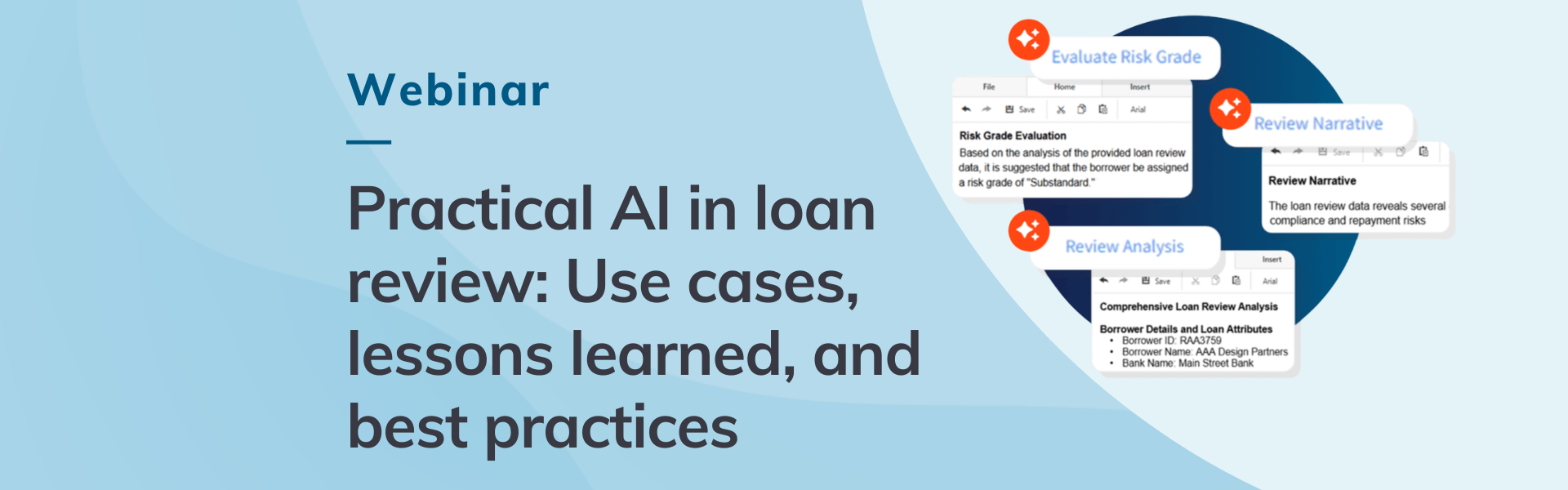



A practical strategy for portfolio balance and growth
Many financial institutions are facing increased rate sensitivity, higher funding costs, evolving customer preferences, and greater competition for funding. These dynamics are prompting leaders to reassess portfolio composition and identify opportunities that support both growth and risk management. One strategy gaining traction is diversifying with equipment finance, which offers a practical way to balance portfolios while continuing to serve business clients effectively.
Traditional lending pressure is forcing a rethink
Banks and credit unions continue to face pressure from multiple directions. Competition for deposits and higher interest rates have increased the cost of funds, contributing to margin compression across the industry. At the same time, regulators expect financial institutions to closely monitor and manage CRE loan portfolios, including evaluating concentration risk and conducting stress testing to identify vulnerabilities.
For example, tightening underwriting standards and elevated vacancy rates in certain CRE segments are prompting institutions to reassess exposure levels and adjust strategies accordingly. Regulators also continue to highlight stress testing and concentration limits as critical tools for mitigating potential losses in changing market conditions.
Banks and credit unions that are exploring ways to rebalance portfolios without sacrificing growth may consider diversifying with equipment finance, which introduces a different asset class with distinct risk characteristics.
Learn how to tap into the equipment financing opportunity in during this webinar.
Watch nowEquipment finance offers built-in diversification
Equipment finance stands apart from traditional commercial lending. Loans are typically shorter in duration and secured by tangible assets, which can help reduce both interest rate risk and loss severity. This structure supports improved portfolio turnover and allows institutions to reprice more frequently in a dynamic rate environment. And according to the Equipment Leasing and Finance Association (ELFA), nearly 80% of U.S. businesses use some form of financing when acquiring equipment, highlighting the widespread adoption of equipment finance as a funding tool.
Because of these characteristics, diversifying with equipment finance can help institutions manage concentration risk while adding a steady flow of shorter-term assets to the balance sheet.
Demand remains resilient because equipment drives revenue
A key strength of equipment finance is the essential nature of the underlying assets. Businesses rely on equipment—from construction machinery to healthcare technology—to generate revenue and maintain operations. As a result, demand for financing tends to remain stable even as economic conditions shift.
The ELFA Foundation Horizon Report notes that equipment investment is closely tied to business productivity and long-term growth, reinforcing the idea that financing demand is driven by operational necessity rather than discretionary spending. Additionally, many businesses choose to finance equipment to preserve working capital and maintain liquidity. This preference creates consistent lending opportunities for financial institutions while helping borrowers manage cash flow more effectively.
It strengthens both yield and relationships
Beyond diversification, equipment finance can enhance both yield and customer relationships. The shorter duration of these loans allows institutions to adjust pricing more frequently, which can be beneficial in fluctuating rate environments. At the same time, the asset-backed nature of the loans can support more favorable risk-adjusted returns.
Equipment needs are also recurring. Businesses regularly upgrade or replace equipment, creating repeat financing opportunities. This enables lenders to deepen relationships through ongoing engagement rather than relying solely on large, infrequent credit exposures.
For community financial institutions in particular, relationship banking remains a competitive advantage. Maintaining consistent touchpoints with borrowers—while managing exposure levels—aligns with the broader goal of sustainable growth and customer retention.
Diversifying the commercial portfolio for stability and flexibility
As institutions navigate margin pressure, regulatory expectations, and evolving market conditions, portfolio diversification remains a priority. Diversifying with equipment finance offers a balanced approach—supporting both risk management and revenue generation.
By incorporating this asset class, banks and credit unions can:
- Introduce shorter-duration, asset-backed loans into the portfolio
- Reduce reliance on more concentrated lending segments like CRE
- Support business clients with essential financing needs
- Create more consistent opportunities for relationship growth
In a complex lending environment, strategies that provide both stability and flexibility are critical. Diversifying with equipment finance allows financial institutions to better manage risk while continuing to meet the needs of the businesses and communities they serve.
This blog was developed with the assistance of ChatGPT, an AI large language model. It was reviewed and revised by Abrigo's subject-matter expert for accuracy and additional insight.
FAQs
What is equipment finance and how does it differ from traditional commercial lending?
Equipment finance is a type of lending used to fund the purchase of business-critical equipment, typically secured by the asset itself. Unlike traditional commercial loans, these loans are usually shorter in duration and tied to tangible collateral, which can reduce risk exposure. This structure also allows lenders to reprice more frequently in changing interest rate environments.
Why are banks and credit unions exploring equipment finance as a diversification strategy?
Financial institutions are turning to equipment finance to reduce concentration risk and offset margin pressure from rising funding costs. It introduces a different asset class with distinct risk characteristics compared to commercial real estate. This helps balance portfolios while maintaining lending activity and revenue generation.
How does equipment finance help manage interest rate risk?
Equipment finance helps manage interest rate risk by offering shorter-term loans that reprice more frequently. This allows institutions to adjust yields in response to market changes. As a result, lenders can better protect margins in volatile rate environments.
What role does equipment finance play in reducing CRE concentration risk?
Equipment finance provides an alternative to heavily concentrated commercial real estate portfolios. By adding shorter-duration, asset-backed loans, institutions can diversify exposure across asset classes. This supports regulatory expectations around concentration limits and portfolio stress testing.
Why is demand for equipment financing considered resilient?
Demand for equipment financing remains stable because businesses rely on equipment to generate revenue and maintain operations. Unlike discretionary spending, equipment purchases are often essential for productivity and growth. Many businesses also finance equipment to preserve working capital and liquidity.
Expanding credit union member business lending? Do this, not that.
Get the guide


Leveraging AI-powered software to gain efficiency
Banks and credit unions that leverage an integrated lending and credit platform reap the benefits of a consistent, efficient, and defensible lending program. Today, many institutions are also exploring how artificial intelligence (AI) can enhance these efforts by improving insights, reducing manual work, and supporting more informed decision-making.
Security, explainability, and efficiency. Learn about Abrigo's AI approach.
Learn more.An integrated, AI-enhanced lending and credit system can help overcome many roadblocks to a streamlined lending program. Below is a short list of the most important features you should look for in researching lending and credit software.
1. Improving transparency into business development.
Lenders track outstanding opportunities and sales activities in spreadsheets, calendars, and notebooks at most institutions. However, it’s challenging for management to measure progress or build predictable forecasts without a centralized system.
An integrated solution provides lenders with a contact database using customer information from the core. It also creates a central location for logging conversations. The increased transparency of an integrated relationship system allows the institution to serve customers better. Management can also hold lenders accountable for achieving their activity goals.
Modern lending and credit software features can also incorporate AI to analyze activity trends, helping identify high-potential opportunities and providing additional visibility into pipeline health.
2. Optimizing the loan origination process.
For many financial institutions, the process of taking a loan from application to closing can take months. It involves numerous bank employees, including business development officers, analysts, credit committee members, loan administrators and outside closing agents. As the prospective loan advances from stage to stage, bottlenecks are common:
- Back and forth with the borrower for required financial documents
- Unbalanced credit analyst workload
- Unresponsive third parties
- Unclear loan-decisioning rules that require added discussion
- Delay as the credit file is passed between parties
- Hunting down the credit file when the bank must report to the borrower on progress
Without a systematic and comprehensive method, consistency and speed are impossible. Loan application software can speed up the process by creating a digital experience that makes document management and processing easier. Coupled with enhanced workflows and automation on the back end, institutions can turn around applications more quickly.
Some lending and credit software features now use AI to extract data from financial documents, highlight missing information, and support more consistent credit analysis. These capabilities help reduce manual effort while supporting lenders’ expertise. By removing the burden of managing daily activities, the management team can focus more on strategic decisions.
3. Tracking outstanding post-closing documents.
This stage of loan management starts immediately after loan closure and includes trailing critical documents. Absent a systematic, proactive process for identifying and tracking outstanding documents, the potential for documents “falling through the cracks” dramatically increases. This can lead to higher institutional risk concerning proper lien perfection, inadequately insured collateral, and regulatory scrutiny.
On the surface, documentation exceptions for loan tracking may seem minor or less critical than underwriting policy exceptions; however, that may not always be the case. The OCC Comptroller’s Handbook on Loan Portfolio Management indicates that this situation can worsen problem loans. It can also greatly hinder efforts to resolve these issues. An automated, centralized system that creates ticklers and exception reports is invaluable. This workflow helps identify patterns that may indicate a weak closing agent or a branch that needs better documentation compliance. Enhanced lending and credit software features can also use AI to identify trends in documentation exceptions and flag higher-risk gaps earlier, helping institutions address issues before they escalate.
4. Collecting current financial information for annual reviews.
According to the Federal Reserve Bank of Atlanta, an effective loan review system should, at a minimum, promptly identify loans with potential credit weaknesses, identify trends affecting the collectability of the portfolio and assign risk grades based on quantitative data.
To conduct a periodic review of commercial borrowing relationships, the institution must have current business and personal financial information. The collection process can be improved with software that defines responsibilities, tracks activities, and logs receipt dates.
A borrower’s failure to provide updated financial information may suggest they are facing financial issues. Quickly identifying borrowers with overdue documents can act as an early warning sign. Some lending and credit software features now incorporate AI-driven insights that help analyze financial trends and surface potential risk indicators earlier in the review process, supporting more proactive portfolio management.
5. Transfer of watch-list credits to special servicing.
Upon certain specified events, primarily a default or breach of covenant, the administration of a loan should be transferred from the banker to special servicing. For example, suppose the loan or relationship has been classified at or above a specific, defined risk level. In that case, the loan file, including collateral and credit documents, will be passed on to the special assets group. This process raises a few procedural questions:
- Will the banker meet with the Special Assets Department to communicate the customer’s financial situation?
- Should Loan Administration consider updating ticklers for financial data to quarterly or monthly instead of annually? Will new covenants be agreed upon and monitored?
- Is a new appraisal being ordered?
- Has the loan been evaluated for impairment?
- Has Special Servicing developed its loss mitigation strategy?
An end-to-end solution can tackle these important questions by following a series of clear steps and approvals. It includes role-based routing and related transfers. AI capabilities within lending and credit software features can further support this process by monitoring portfolio data for risk triggers and helping institutions identify when a loan may require additional attention. In other words, the advantages of an automated process extend beyond underwriting and servicing.
Smarter AI, built for bankers. Learn how Abrigo's AI-powered solutions can help.
Get a demo



Align credit risk functions for a sound credit risk framework
Authority, accountability, and oversight of credit risk need to move together. Once those elements are split across functions without clear alignment, the institution has a credit risk framework that looks disciplined but behaves otherwise.
The challenge with credit risk: execution
At its simplest, credit risk is the possibility of loss when a borrower fails to repay a debt as agreed. Straightforward enough. Yet anyone who has spent time in banking knows the real challenge with credit risk lies not in the definition, but in the execution.
I am not an academic. I’m a retired country banker who watched his first bank fail early in his career—brought down by a toxic mix of ignorance, hubris, and poor judgment. Everything I did afterward was shaped by a single goal: don’t let that happen again.
We are now more than fifteen years removed from the Great Financial Crisis. The pandemic, while severe, was a different animal. At last, regulators appear to be unwinding some of the inevitable overreactions that followed 2008. The OCC’s recent proposal to raise the “heightened standards” threshold from $50 billion to $700 billion is one such example. I have no intention of formally responding to the OCC’s 32 questions in the proposal. It does, however, raise a broader issue worth discussing, and that is credit risk ownership.
Limit the "noise" within credit risk. Download this checklist for managing exceptions.
Download checklist“Three lines of defense” falls short for credit risk
The “three lines of defense” model for credit risk has become deeply embedded in regulatory and institutional thinking. Its premise is simple:
- The first line owns and manages risk
- The second line provides oversight and challenge
- The third line provides assurance
In theory, it’s neat and orderly. In practice, especially for credit risk, it creates confusion.
The line disclaims ownership because it didn’t approve the deal. Credit expects the line to perform monitoring functions it isn’t trained for. Loan Review can’t report to Credit without compromising “independence,” so it reports elsewhere, often to someone who doesn’t fully understand the function. Internal Audit is then expected to audit Loan Review, though few institutions have figured out how to do this effectively.
The result is a Kafkaesque loop where credit risk responsibility is diffused and accountability diluted. Everyone is involved, yet no one truly owns the risk.
Authority, accountability, and oversight need to move together. Once those elements are split across functions without clear alignment, the institution has a credit risk framework that looks disciplined but behaves otherwise.
Credit risk is a team sport
Country banking thrives on simplicity, so let’s simplify.
One of the failures at my first bank was excessive individual lending authority. The industry responded by swinging the pendulum hard in the other direction, stripping authority from the line and pushing approvals almost entirely into Credit. Today, it’s not uncommon to see institutions with enormous legal lending limits and minuscule line authority.
That structure destroys accountability.
When the line is expected to own and manage credit risk, it must have meaningful authority and be held responsible for its decisions. That authority has to operate within guidance and within limits. In my career, I encountered only a handful of truly rogue lenders. Most people simply want to do their jobs well, provided they have clear guidance and appropriate tools.
Credit’s role is not to do the line’s work. It is to set clear, durable guardrails. Unfortunately, as authority has migrated inward, policy discipline has eroded. When the approach is that “everything goes to Credit anyway,” policy adequacy becomes an afterthought.
That approach no longer works. Fintech competitors are faster precisely because their frameworks are simpler and aligned with how risk actually manifests. Credit policies must be concise, sustainable, and clearly tied to the institution’s risk appetite, which, importantly, must actually exist.
Not all credits warrant the same level of scrutiny. Complexity matters. Exposure matters. A $5 million credit and a $500,000 credit should not move through identical credit decisioning processes. Treating them as such is inefficient and, frankly, irrational.
Loan Review’s role is to ensure those guardrails make sense and function as intended. That does not mean citing endless, immaterial exceptions. It means asking harder questions at the portfolio level:
- Do policies clearly reflect expectations by segment?
- Does the credit risk-rating framework reveal migration early enough to act?
- Are people performing their roles responsibly?
- Where is risk accumulating out of sight, and is concentration credit risk being surfaced in time?
Independence without isolation
Much of the angst around Loan Review centers on independence. The regulatory framework already provides a solution. The OCC’s standards allow for multiple Chief Risk Executives. A Chief Risk Officer is one, a Chief Credit Officer is another. A Chief Credit Review Officer, reporting directly to the board with a dotted line to the CEO, preserves independence while enabling full collaboration with Credit, Risk, and the business line.
Independent loan review does not require isolation. It requires clarity. It also depends on relevance. Loan Review should be able to inform Credit, challenge assumptions, and surface patterns that require action. Isolation makes that harder. Independence and collaboration can coexist when reporting line, authority, and purpose are clear.
Credit risk is dynamic
Credit frameworks are often built like monuments—carefully constructed, then treated as immutable. That’s a mistake.
Credit risk behaves more like a wave than an edifice. It shifts with borrower behavior, economic conditions, portfolio composition, regulatory change, and people. A framework built for a moment in time inevitably develops blind spots.
My first employer’s failure was accelerated by an inability to adapt to legislative changes that reshaped commercial real estate lending. Rigid structures and ritualized processes all contributed.
Credit functions that focus on guardrails rather than micromanagement are better positioned to identify emerging risks and respond tactically and strategically. The same is true for Loan Review. When review becomes overly ritualistic, it misses trends that matter.
That is why ownership matters so much. A dynamic risk environment requires people with clear authority, clear responsibility, and a framework that can adjust. At a minimum, institutions should conduct a bipartisan review of credit policy, guidance, and review processes every two years, and more frequently when conditions warrant. “Bipartisan” means collaboration between those who own risk and those who oversee it, with Loan Review contributing insight without compromising independence.
So, who owns credit risk?
Credit risk is exactly what we said at the outset: the possibility of loss when a borrower fails to repay. The challenge isn’t definition. The challenge is ownership.
By clinging to arbitrary constructs and reacting to long-past crises, we’ve blurred accountability to the point where everyone is responsible, and therefore no one is. The solution isn’t radical. It’s a reset: clarify roles, restore accountability, and adopt frameworks that are simple, dynamic, and fit for purpose.
The line needs meaningful authority and responsibility. Credit needs to establish guardrails and maintain discipline. Loan Review needs to determine whether the system is working and where it is not. Those roles differ, but they have to connect.
Institutions that fail to take these steps risk joining the thousands that didn’t fail spectacularly but instead faded into irrelevance.
Partnering with Abrigo, you can adopt AI where and how it's right for your financial institution. With security and explainability.
Explore AI products


KYC naming conventions: How name structures impact AML/CFT risk
Client-centric know your customer (KYC) programs help financial institutions strengthen relationships while improving the accuracy of client identification. As client bases become more diverse, institutions must account for KYC naming conventions that extend beyond the traditional Western format of first, middle, and last name.
This article covers these key topics:
This is not only a data entry challenge. Differences in naming structures can directly affect transaction monitoring, sanctions screening, and customer due diligence (CDD). Without the right approach to KYC naming conventions, institutions risk missed matches, increased false positives, and regulatory scrutiny.
Understanding how naming conventions vary and how to operationalize that knowledge is essential for building a more effective anti-money laundering/combating the financing of terrorism (AML/CFT) program.
Key risks tied to KYC naming conventions gaps
When systems and processes are designed around Western naming formats, several risks can emerge:
- False positives increase when similar names are flagged without sufficient context, driving up investigation workload
- False negatives occur when variations in name order or spelling prevent accurate matching against sanctions lists
- Regulatory risk rises when customer identification and screening processes are not reasonably designed to capture true risk exposure
Addressing these risks starts with strengthening institutions' KYC naming conventions across onboarding, ongoing monitoring, and investigations.
Staying on top of fraud is a full-time job. Let our Advisory Services team help when you need it.
Connect with an expertWhy KYC naming conventions matter in CDD and monitoring
Names are a foundational data point in KYC and CDD processes. They are used across account opening, transaction monitoring, sanctions screening, and case investigations. When naming conventions vary, inconsistencies can appear across systems, documents, and transactions.
These inconsistencies may include:
- Reversed name order
- Multiple surnames or family names
- Transliteration differences when converting names into the Roman alphabet
- Use of preferred or adapted names alongside legal names
Without proper handling, these variations can reduce match accuracy, increase alert volumes, and create inefficiencies for AML teams.
Common naming conventions
Western naming conventions
In many Western countries, names typically follow a first name, middle name, and family name structure. Systems and forms are often designed with this format in mind, which can create limitations when onboarding customers with different naming structures.
AML consideration:
Rigid field structures can result in incomplete or misaligned data, affecting downstream screening and monitoring.
Chinese naming conventions
In Chinese naming structures, the family name comes first, followed by the given name. Given names may consist of one or two parts. When converted into the Roman alphabet, names can have multiple valid spellings depending on the transliteration method.
AML considerations:
- Name order may be reversed across systems and documents
- Multiple spellings can reduce match accuracy in sanctions and adverse media screening
- Gender is not always identifiable from the name alone, which may affect certain risk assessments
Hispanic naming conventions
Hispanic naming traditions often include two surnames. The first is typically the father’s paternal surname, followed by the mother’s paternal surname. Individuals may use both surnames, hyphenate them, or use only one depending on context.
AML considerations:
- Systems may capture only one surname, leading to incomplete customer records
- Variations in surname usage can impact matching across systems and documents
- Retention of full names after marriage may differ from Western expectations
Russian naming conventions
Russian names typically include a given name, a patronymic derived from the father’s first name, and a family name. The patronymic includes gender-specific suffixes, and family names may also change form based on gender.
AML considerations:
- Patronymics may be omitted or inconsistently recorded across systems
- Gender-based variations in surnames can affect matching logic
- Multiple name components increase the likelihood of data inconsistency
Building a more resilient approach to KYC
As financial institutions serve increasingly diverse communities, the ability to accurately interpret and manage KYC naming conventions becomes more important. Effective programs balance compliance requirements with operational efficiency and a strong customer experience.
By strengthening data collection, improving matching logic, and equipping teams with the right context, financial institutions can reduce risk while supporting more accurate and efficient AML processes.
A more flexible and informed approach to KYC naming conventions not only enhances compliance but also helps institutions better serve their customers in a globalized environment.
Strengthening AML/CFT programs to address KYC naming conventions
Financial institutions can take practical steps to improve how KYC naming conventions are captured and used across AML/CFT processes.
Enhance customer data collection
- Capture full legal names as they appear on official documentation
- Include fields for aliases, alternative spellings, and preferred names
- Allow flexibility in name order and structure rather than enforcing a fixed format
Improve screening and monitoring processes
- Use matching logic that accounts for name order variations and multiple surnames
- Incorporate fuzzy matching and phonetic search capabilities
- Account for transliteration differences when screening against watchlists
Support investigators with better context
- Add internal notes or alerts to explain naming structures and variations
- Train staff on common global naming conventions and associated risks
- Ensure consistent data is available across systems to reduce rework
Align processes with a risk-based approach
- Evaluate how naming complexity affects your institution’s risk profile
- Adjust procedures for higher-risk customer segments or geographies
- Periodically review data quality and matching effectiveness
Find out how Abrigo Fraud Detection stops check fraud in its tracks.
Fraud detection softwareFAQs
What are KYC naming conventions?
KYC naming conventions are the ways personal names are structured across different cultures, languages, and jurisdictions. In AML/CFT compliance, understanding KYC naming conventions helps financial institutions collect more accurate customer data and improve customer due diligence, sanctions screening, and transaction monitoring.
Why are KYC naming conventions important in AML screening?
KYC naming conventions are important because name structure differences can affect match accuracy in AML screening workflows. When banks and credit unions do not account for reversed name order, multiple surnames, or transliteration differences, they may increase false positives, miss true matches, and create more compliance risk.
How do global naming conventions affect customer due diligence?
Global naming conventions affect customer due diligence by creating inconsistencies across onboarding forms, identity documents, watchlists, and internal systems. A stronger KYC process helps financial institutions capture full legal names, aliases, and alternate spellings so AML teams can make more accurate risk decisions.
What naming convention challenges create false positives or false negatives?
Common challenges include Chinese name order, Hispanic double surnames, Russian patronymics, and transliterated names written in multiple valid spellings. These issues can reduce the effectiveness of sanctions screening and transaction monitoring when institutions rely on rigid Western-style name fields.
How can financial institutions improve KYC naming convention workflows?
Financial institutions can improve KYC naming convention workflows by using flexible data fields, capturing aliases and preferred names, and applying matching logic that accounts for spelling, order, and transliteration variations. This approach helps banks and credit unions strengthen AML compliance while reducing manual review volume.
This article covers these key topics:
- What is digital lending for banks and credit unions?
- How common is digital lending among financial institutions and which lending segments are most/least digitized?
- What parts of the lending process should institutions digitize first, and what benefits will they see?
- Does digital lending replace the relationship lender?
Questions & answers about online loan origination
Digital lending can deliver faster and more efficient credit decisions. It's increasingly common among banks and credit unions, and it yields numerous benefits outlined below.
Q: What is digital lending for banks and credit unions?
A: Digital lending is the use of online technology to originate and renew loans in order to deliver faster and more efficient credit decisions. Digital lending can start as basic as an online loan application offered by a bank or credit union on its website. It can also be as comprehensive as an entirely automated loan origination system that digitizes the full process using software for an online loan application, document capture, electronic signatures, automated credit analysis, loan pricing, loan decisioning, and loan administration.
Also see this infographic: "Before & after: Digital lending and credit automation"
Download infographicQ: Why is it urgent for community banks and credit unions to adopt digital lending?
A: In the world of Amazon same-day deliveries and instant payments, convenient options for applying for credit are table stakes. Non-bank lenders already offer them, and digital financial tools are everywhere. Consider this: More than three-fourths of consumers use fintech applications, according to a recent survey of 2,000 U.S. adults by Plaid and the Harris Poll. One in every five expect to use an app for lending services in the next six months—up from 10% in 2020. Finally, the same consumer survey found nearly half of consumers consider the typical loan application process too confusing; 39% said it was challenging to even successfully complete a loan application. Traditional lending processes also cost more. “Banks can realize huge gains in operational efficiency by automating more manual processes, using workflow management tools and underwriting algorithms that spit out decision and approval. They can also use digital tools to raise employee productivity,” write Bain & Co. advisors. The firm has long recommended banks modernize lending processes to avoid a material decline in profits and loss in market share.
Q: How common is digital lending among traditional financial institutions?
A: According to a 2024 survey by Digital Banking Report Research, 90% of institutions allowed consumers to apply online for consumer credit, such as a personal line of credit, a credit card, or an auto loan. Sixty-five percent reported providing mobile apps for borrowers to apply for consumer credit. However, many types of credit applications still require in-person visits to a branch. Only 36% of financial institutions rely on digital lending platforms for more than half of their lending processes, according to PYMNTS Intelligence’s 2024 State of Digital Lending Readiness Report.
Q: Among financial institutions, which lending segments are most and least digitized today?
A: Across all product types, nearly 90% of financial institutions make available online/web applications for credit, an increase from 76% in 2019, according to Digital Banking Report’s 2024 State of Digital Lending study. However, most potential borrowers can complete only a portion of the entire credit application process online. That’s especially the case for business or commercial loans, student loans, and mortgages. Small business and commercial lending processes are the least digitized, and credit cards and unsecured personal loans are the most, according to the study.
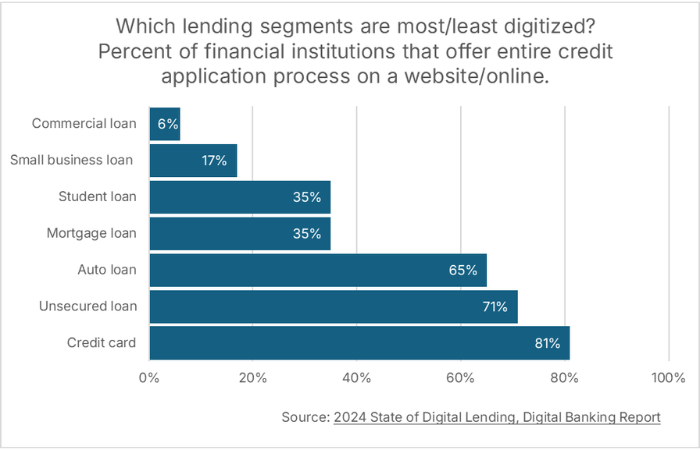
Q: What parts of the lending process should institutions digitize first, and what benefits will they see?
A: Focus on three areas:
1. Information collection: Clarify requirements upfront, reduce borrower frustration, and prevent delays from incomplete files. Online applications create a single data source and reduce the risk of errors from rekeying data. Financial packages update automatically as data is added, and staff don’t spend as much time emailing and calling for incomplete loan applications. Once the borrower signals with a completed file that they are ready to move forward with the application, the processing and underwriting can proceed more efficiently.
2. Workflows: Digital lending software that utilizes configurable workflows means all information related to a borrower can be seen in one centralized place, and the steps of a decision can be documented for improved audit tracking. Connecting multiple data sources into a single interface enables loan processors or analysts to import information from third parties, such as credit bureaus, insurance firms, appraisal firms, and other financial institutions. This reduces errors and extra work, speeding up the decision-making process.
3. Analytics and intelligence: Standardize calculations and analyses to improve consistency and reliability across lenders, underwriting teams, and branches. A digital platform can analyze, price, and recommend loan decisions more quickly while generating portfolio insights that support better risk understanding and strategic decisions. Management and boards can more easily see concentration risk and growth opportunities.
Q: How does digital lending improve the borrower experience and help institutions grow without adding staff?
A: Digitization speeds up decisions, increases transparency about requirements and timelines, and reduces rework from errors or missing documents, directly improving the borrower or member experience. For example, Abrigo’s AI-powered Lending Assistant generates credit narratives 25% faster, validates documents, and extracts key data from unstructured files. For the institution, efficiency gains translate into lower operating costs, better profitability, and the capacity to close more loans and increase revenue per loan. This fosters growth in loan portfolios without proportionally increasing staff or risk, and can free resources to enhance service or help contain fees and rates.
Q: Does digital lending replace the relationship lender in many community banks and credit unions?
A: No. Automating time-consuming lending processes, such as document collection and financial spreading, does not replace the lender’s relationship. Instead, it allows staff who normally handle those tasks to direct their time to talking with the customer or member and other staff about needs and which products serve them best. They can also spend more time educating applicants on the credit process and how borrowers can improve their chances of loan approval. In addition, some business borrowers prefer to begin applying in person. For example, Academy Bank’s recent survey of more than 200 entrepreneurs found that more than half applied for loans in a branch, and those working with a dedicated business banker reported positive experiences. However, the survey found a digital-first mindset among younger generations. More than half of Gen Z business owners and 43% of Millennials prefer digital banking options—whether it’s applying online, using mobile tools, or managing their accounts virtually.
Q: What's the role of AI (artificial intelligence) in digital lending?
A: AI is transforming digital lending, making processes even faster and less burdensome for busy lenders and credit analysts. For example, Abrigo's AI-powered banking agent, AskAbrigo, is integrated with the loan origination system. Instead of lenders searching through scattered loan files, emails, and policy documents on SharePoint to prepare for a prospect meeting, AskAbrigo can create a comprehensive relationship summary (loans, deposits, ticklers, covenants, guarantors, potential concerns, topics to discuss) from the institution's own data and files, then create a calendar activity and link a summary that can be used to guide the conversation. Early users report saving anywhere from 30 minutes to 5 hours a week on various use cases.
Helping more borrowers get answers quickly
Innovations in digital lending will continue as financial institutions seek additional ways to serve their customers or members while protecting the safety and soundness of the institution. Technology enables an institution to infuse more of its unique banking expertise into workflows, thereby retaining its relationship-driven advantages and preserving community lending.